
Manufacturing Production Scheduling Software for Modern Planners
Manufacturing production scheduling software must support planners working in environments where change is constant and assumptions expire quickly. SyncManufacturing® delivers real-time schedules, live visibility into work orders and constraints, and adaptive sequencing designed for discrete manufacturing. Built for planners, supervisors, and production control teams, it helps manage volatile daily workloads while improving execution reliability, coordination, and confidence across the shop floor.









Why Modern Production Scheduling Requires Real-Time Adaptability
Production schedulers struggle with spreadsheets and traditional ERP scheduling modules because those systems are designed for static planning cycles. Schedules are often created based on fixed assumptions about resources and are then published to the business as a plan that quickly becomes obsolete. As conditions change throughout the day, planners are forced to manually intervene to keep production on-track.
Real-time adaptability changes how planning and scheduling works. Instead of reacting after issues surface, real-time production scheduling automatically adjusts as demand and constraints shift. Advanced Planning and Scheduling logic continuously evaluates labor availability, machine capacity, tooling readiness, material status, and routing dependencies. When disruptions occur, priorities are recalculated immediately using constraint logic, eliminating manual rework . This shared view simplifies planner and scheduler workflows by keeping priorities, status, and risks aligned across teams.

Common disruption triggers include:
- Material delays, partial receipts, or supplier variability that prevent jobs from starting as planned. When components arrive late or incomplete, downstream operations are forced to wait or resequence work, increasing planner workload and execution risk.
- Labor changes caused by absences, skill constraints, or reassignment that reduce available capacity or limit which operations can be performed. Even short-term labor gaps can ripple through schedules when skill requirements are tightly matched to specific work centers.
- Machine downtime, reduced capacity, or unplanned maintenance that instantly invalidate static schedules. Equipment issues often require immediate resequencing to maintain flow and prevent delays across dependent operations.

Core Scheduling Capabilities for Production Teams
Effective production scheduling requires more than placing jobs on a timeline. Planners need tools that reflect how manufacturing actually operates, accounting for real constraints while providing clarity on priorities and capacity. Modern scheduling software supports both production scheduling and production planning by connecting demand, capacity, and execution into a single, continuously updated plan.
Schedulers rely on software that helps forecast capacity accurately, understand trade-offs, and sequence work without overloading resources. By grounding schedules in constraint logic and real-time data, production teams can maintain flow while responding to change with confidence.
Core scheduling capabilities include:
- Constraint-based sequencing and job prioritization that simultaneously considers labor, machines, tooling, and materials. Schedules are built around actual resource availability and operational constraints, ensuring work is sequenced in a way that is executable on the shop floor rather than based on theoretical capacity.
- Detailed WIP visibility and job progress tracking across routing steps and work centers to support informed decisions. Planners can see where work is currently located, what is in queue, and what is in process, allowing them to anticipate issues and adjust priorities before delays occur.
- Program- or customer-based scheduling that aligns execution priorities with delivery commitments and business objectives. This approach ensures high-value or time-sensitive orders receive the appropriate focus without manually reworking schedules throughout the day.
- Scenario modeling for capacity changes, such as overtime, shift changes, or alternate resources, allowing planners to assess impact before execution. Planners can evaluate trade-offs and choose the most effective option without disrupting live production schedules.
- Finite capacity scheduling to prevent overcommitment and support stable, predictable production flow. By respecting real capacity limits, schedules remain achievable, reducing last-minute changes and improving confidence across planning, supervision, and production control teams.
Connected Scheduling Across Multi-Site Operations
As manufacturing organizations scale, scheduling complexity increases across plants, regions, and product lines. Without coordination, each facility may operate with different calendars, priorities, and assumptions, leading to misalignment and inconsistent results. Connected scheduling brings structure to multi-plant networks while preserving local execution flexibility.
APS for production schedulers supports multi-site production coordination by establishing centralized scheduling standards that are applied consistently across facilities. At the same time, each plant retains the ability to manage local constraints, labor patterns, and operational realities. Cross-site visibility allows planners to understand WIP, capacity, and constraints across the network, enabling decisions that align production across programs and customers.
Connected scheduling across multi-site operations includes:
- Centralized scheduling standards paired with local execution flexibility
- Cross-site WIP visibility and synchronized constraint logic
- Scalable support for networks ranging from 20 to 200+ facilities
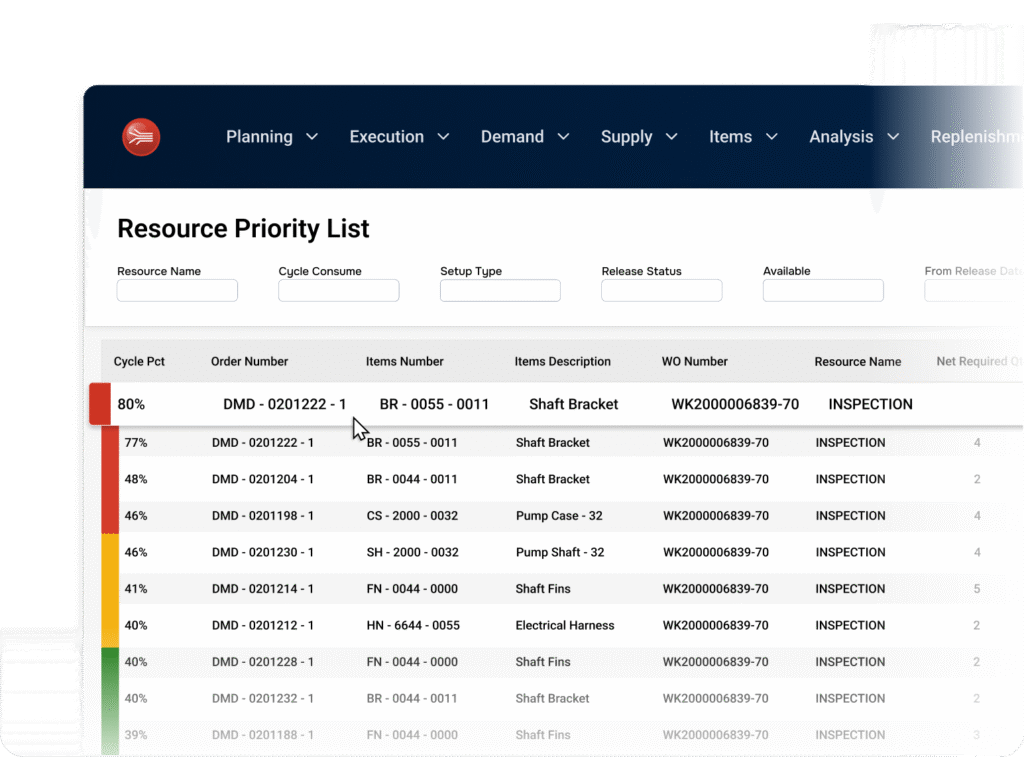
Automated Alerts to Minimize Production Disruptions
Manual monitoring consumes planner time and increases the risk of missed issues. Automated alerts provide early warning when conditions change, allowing teams to respond before disruptions escalate and impact delivery.
With real-time manufacturing alerting through SyncAlert®, event-driven notifications are routed directly to the right stakeholders. Alerts are prioritized by program or customer commitments, reducing emergency floor walks and manual checks while supporting proactive decision-making.
Common alert types include:
- Material shortages or delayed receipts
- Machine downtime or capacity reductions
- Quality inspection holds or rework triggers
- Late operations or missed start times

Demand-Driven Replenishment Support for Schedulers
Scheduling stability depends on reliable material availability. Traditional replenishment approaches often create excess WIP or shortages that disrupt execution and force planners into reactive adjustments. Demand-driven scheduling improves stability by tying replenishment directly to production signals.
With eKanban software like SyncKanban®, replenishment is automated based on actual consumption. This approach reduces shortages, limits excess inventory, and improves alignment between material flow and production priorities.
Core scheduling capabilities include:
- Reduced material shortages that disrupt schedules
- Lower excess WIP tied to speculative ordering
- Improved material availability and flow consistency
Implementation Requirements for Accurate Scheduling
Accurate constraint-based scheduling depends on reliable data and tight system integration. ERP and MES platforms provide essential inputs that inform scheduling calculations and ensure plans reflect shop-floor reality.
ERP/MES scheduling integration synchronizes routings, bills of material, inventory levels, and machine status with the scheduling engine. Engineering change orders update APS schedules automatically, preserving alignment as product definitions evolve and reducing manual reconciliation.
All capabilities operate within the Synchrono Platform, ensuring consistent data, governance, and execution across planning and operations. This level of integration supports constraint-based scheduling software that remains accurate as conditions change.
Implementation typically includes:
- ERP/MES-based routings, BOMs, inventory, and machine status
- Real-time WIP and material flow data
- Automated ECO updates synchronized to scheduling logic

Improve Planner Efficiency and Scheduling Reliability
Modern planners need tools that adapt as fast as manufacturing changes. Real-time, adaptive, constraint-based scheduling improves execution confidence, reduces manual effort, and supports consistent delivery performance across teams and facilities.
See how advanced planning and scheduling software helps planners manage volatility with clarity and control, and see how other manufacturers have applied these capabilities successfully through our manufacturing case studies.