

The semiconductor industry is competitive, with efficiency and reliability being paramount for success. Johnstech International has consistently delivered results that surpass industry standards, most notably achieving a remarkable reduction in lead times to just 3-4 weeks, compared to the typical industry standard of 5-8 weeks. This achievement underscores their use of advanced planning, scheduling, and execution technology, setting a new benchmark for operational excellence. As manufacturers face the challenges of complex supply chains and market fluctuations, Johnstech’s approach over the last two decades stands out as a powerful example of how to optimize production and ensure timely delivery.
The Challenge: Navigating a Volatile Market
The semiconductor market is characterized by fluctuating demand and intricate production cycles. The global chip shortage during the pandemic amplified existing pressures, making on-time delivery a critical differentiator in the competition. For Johnstech, maintaining its position as a top-tier provider of test contactor solutions meant addressing several key operational hurdles:
- Meeting Aggressive Deadlines: The industry standard for lead times can stretch from 5 to 8 weeks. Johnstech needed a system to consistently outperform this average.
- Managing Complex Production: The nature of Johnstech products required a dynamic scheduling system capable of handling complex dependencies and priorities in real time.
- Ensuring Visibility: A lack of real-time visibility across the production floor can lead to bottlenecks, delays, and inefficient resource allocation.
To sustain growth and meet customer expectations, Johnstech required a solution that could synchronize its entire manufacturing environment, from the shop floor to the executive level. The goal was to build a resilient, demand-driven operation that could adapt to market shifts without sacrificing quality or speed.
The Solution: Real-Time Visibility and Dynamic Planning and Scheduling
Johnstech partnered with a leading technology provider renowned for its patented synchronization algorithm that revolutionizes manufacturing efficiency. This partnership enabled the implementation of a suite of powerful demand-driven software tools, including SyncManufacturing® and SyncView®. This strategic integration was designed to provide a cohesive, real-time view of the entire manufacturing ecosystem.
Real-Time Planning and Execution with SyncManufacturing®
SyncManufacturing® provided Johnstech with an advanced planning and scheduling (APS) system that synchronized and prioritized all critical resources. This system moves beyond traditional enterprise resource planning (ERP) RP limitations by offering a dynamic, real-time approach to production management. The software managed constraints and adapted fluidly to drive flow and ensure on-time production. Synchronizing the entire supply chain allowed Johnstech to manage priorities, status, equipment, and alerts with unparalleled precision. This capability was instrumental in optimizing workflows and minimizing idle time.
Unprecedented Visibility with SyncView®
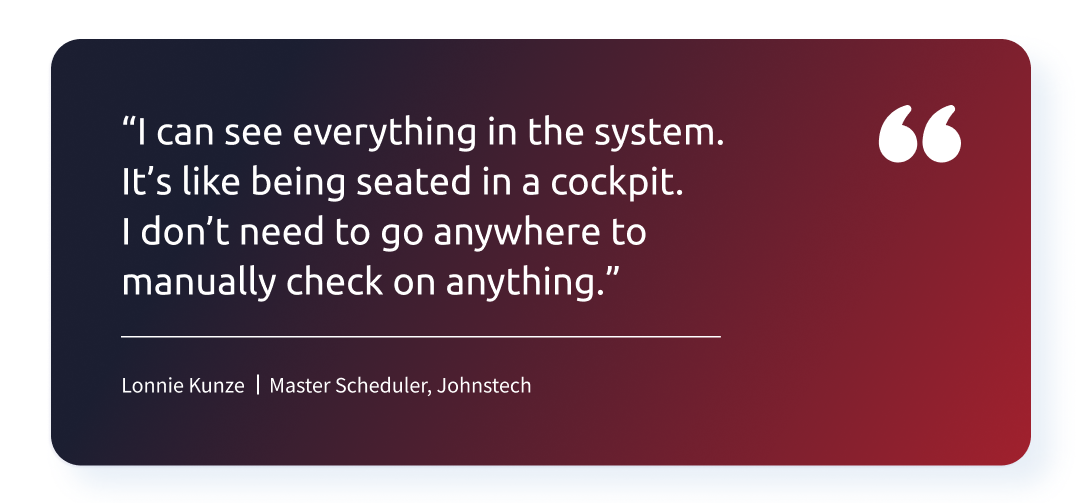
Complementing the APS system, SyncView® created a real-time visual factory. This tool provided multi-enterprise visibility, keeping every level of the organization synchronized and informed. Decision-makers, planners, and operators gained access to live data on priorities, equipment status, and potential constraints. This level of transparency empowered teams to make proactive, data-driven decisions. Instead of reacting to disruptions, they could anticipate and mitigate them, keeping production schedules on track. The visual interface made complex data accessible and actionable for all stakeholders.
The Results: Setting a New Industry Standard
The implementation of this integrated software suite yielded transformative results for Johnstech, solidifying its reputation for reliability and performance. The data speaks for itself.
Industry-Leading Times
By optimizing every facet of its production process, Johnstech dramatically reduced its lead times. The company now consistently delivers complex, custom solutions in just 3 to 4 weeks, a stark contrast to the industry average of 5 to 8 weeks. This speed provides Johnstech and its customers with a significant competitive advantage, especially in a market struggling with the global chip shortage.
Exceptional On-Time Delivery
Another impressive outcome is Johnstech’s ability to surpass a on-time delivery goal of 95% and maintain a 98-99% on-time delivery rate. This near-perfect record is a direct result of the real-time synchronization and advanced planning capabilities of its new system. For customers in the semiconductor industry, where project timelines are rigid and delays are costly, this level of reliability is invaluable. It demonstrates a mastery of the supply chain and a deep commitment to customer success.
Get the Full Story
The Johnstech story is more than just a case of successful software implementation; it is a testament to the power of demand-driven manufacturing. By embracing real-time data and advanced planning and scheduling, the company has not only weathered the global chip shortage but also thrived. Their ability to deliver faster and more reliably than competitors offers a compelling model for any manufacturing leader aiming to optimize operations.
To get the complete details of how Johnstech achieved these remarkable outcomes, download the full case study. Discover the specific strategies and technologies that enabled them to redefine performance in semiconductor testing.