Tag: operational technologies

  • Synchronized Manufacturing: Using Supply Allocation to Orchestrate Complex Build Structures

    Synchronized Manufacturing: Using Supply Allocation to Orchestrate Complex Build Structures

    It’s amazing to watch a school of fish swimming—each one turning, accelerating, and slowing in perfect unison, as if they were a single organism. Their very survival depends on synchronization. Staying tightly coordinated lets them react instantly to predators, shift around obstacles, and navigate a vast, unpredictable ocean.    

    Complex manufacturing environments work much the same way. To keep customers satisfied and costs under control, multi-level builds with dozens, or even hundreds, of interrelated work orders must move together with that same fluid coordination. When even one critical operation falls out of sync, the whole schedule ripples: delivery promises slip, priorities become confused, and planners are left scrambling to get everything back on track.  

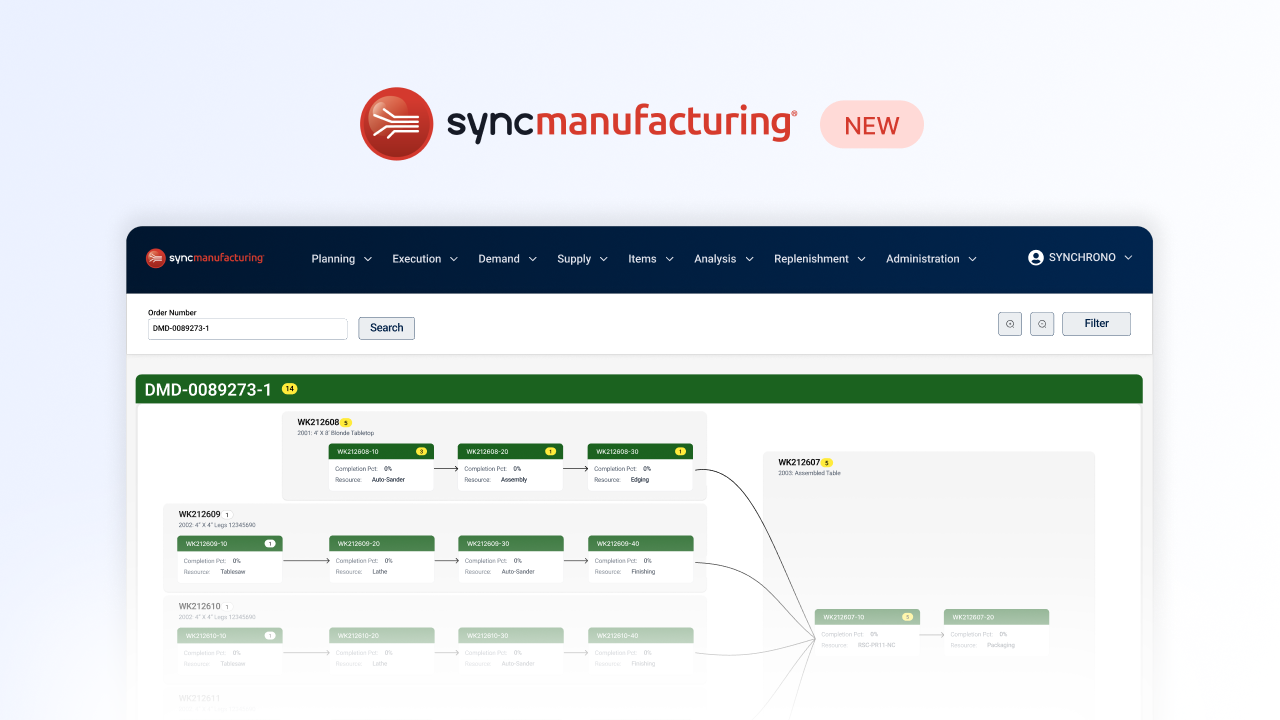
    Supply Allocation, a new feature in SyncManufacturing Version 8, can help restore that “school of fish” coordination to your operations by recoupling every level of your build structure into a single, coherent flow.  

    The Hidden Complexity of Multi-Level Manufacturing

    In complex manufacturing, every finished product often relies on a deep, multilevel bill of material with its own chain of supporting work orders. A single customer order can depend on hundreds of work orders, each with its own routing, lead times, and dependencies. Small delays deep in the build structure can cascade into major disruptions, expensive expediting, and late deliveries. 
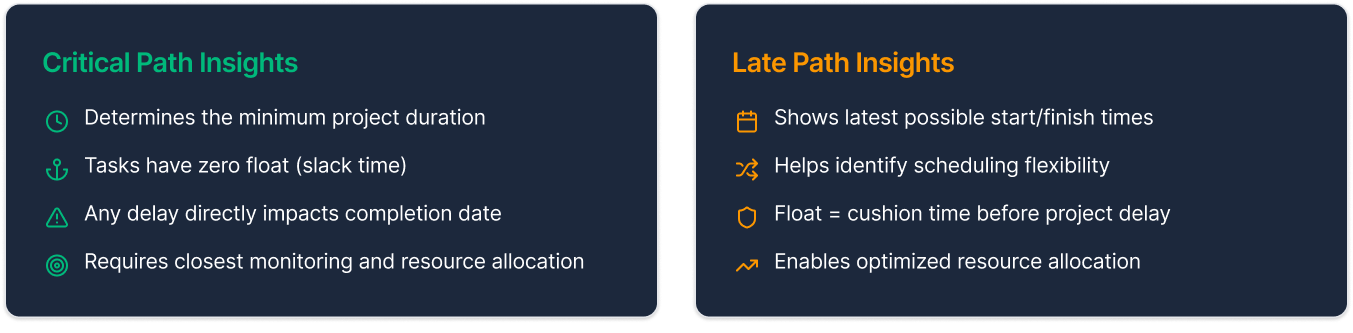
    Two scheduling concepts were developed to help manufacturers address this issue: the critical path and the late path. Critical path is the sequence of activities that determines the overall project or order completion date. Tasks on this path have zero (or near-zero) float: If any of them slip, the order completion date slips by the same amount. Late path refers to the set of late start and late finish times calculated for activities in a schedule, showing how late each task can occur without delaying the overall completion date.   

    While transformative, these concepts were developed in the 1950s, at the very beginning of the computer age. Since then, industries such as aerospace and defense, automotive manufacturing, and heavy equipment have grown far more complex.  

    • ERP/MRP systems often treat each work order as an isolated record rather than part of an end-to-end build structure for a specific customer order.   
    • Standard pegging logic shows only theoretical links between supply and demand, without clearly revealing which orders are at risk or how they affect downstream operations, making proactive action difficult.  
    • Planners must compensate for variability by manually resetting due dates to force alignment, a labor-intensive process that quickly becomes unmanageable as priorities and constraints shift.  

    The result is a schedule that looks aligned on paper but is often disconnected from shop-floor realities. Machines and labor are booked on jobs that cannot start due to a lack of materials, work is released to the floor before components are available, and high-priority orders are inadvertently starved while lower-priority orders consume critical parts.  

    This historical reliance on limited pegging functionality and manual date setting is understandable. True, end-to-end, dynamic pegging can be computationally intensive, especially across thousands of orders, multi-level BOMs, and constantly changing schedules. But with the exponential growth in computing power and modern optimization techniques, it is now possible to continuously recalculate detailed, order-level relationships in near real time, opening the door to a new paradigm.  

    Aligning Flow Instead of Dates: How Supply Allocation Works

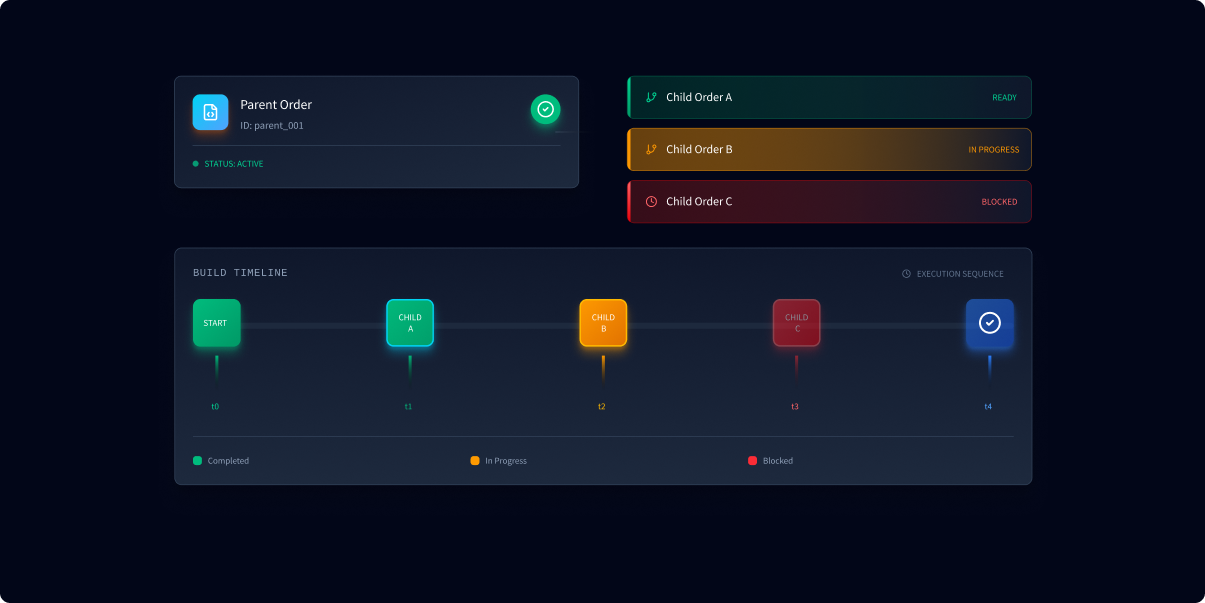
    Supply Allocation starts with the understanding that a customer order build is not a collection of isolated tasks. Rather, it is a system of tightly related work orders that must flow together. To achieve this level of synchronization, Supply Allocation builds direct linkages between every supply order (what is being made or bought) and every demand order (what is needed for the customer or parent job) across all BOM levels.  

    This means alignment is no longer defined by manually maintained date fields. Rather, it is defined by flow.  

    • Every child order knows exactly which parent order it supports and how its timing affects the overall build.  
    • The system can schedule the entire build structure as one extended process, ensuring that upstream and downstream work move in lockstep.  
    • When conditions change—late material, capacity constraints, priority shifts—the impact on the entire structure is visible in a single, coherent model rather than scattered across screens and independent work orders.  
    • Dates across the entire build are automatically recalculated from these relationships, so schedules stay aligned without constant manual due date resets.  

    By treating the order as a system, Supply Allocation transforms planning from a reactive exercise in chasing dates into a proactive discipline focused on orchestrating flow through the value stream.  

    The Value and Outcomes of Supply Allocation

    When every work order in a multilevel build is aligned through Supply Allocation, the operational benefits are immediate and measurable.  

    Maximized throughput: Supply is strictly aligned with demand, so every part on the shelf, on order, or in production has a clearly defined destination within a customer order.  

    Improved transparency: Users gain an at-a-glance view into the full structure of an order, from top-assembly to the lowest level component, including which steps are driving delays.  

    Increased efficiency: Planners no longer spend hours manually validating material availability or stitching together order relationships because the system automatically surfaces the critical path and late path.  

    Reduced delays and stoppages: Jobs are released to the floor only when they are truly buildable, reducing stalled work, WIP, and the confusion that comes from jobs waiting on missing parts.  

    More reliable delivery: Promise dates are grounded in validated supply-demand linkages, leading to more consistent demand linkages, on-time delivery, and higher customer confidence. Increased transparency improves expediting of at-risk orders.   

    Supply Allocation: More Vital Than Ever

    These days, manufacturers are under pressure from every direction: tighter lead times, more product variants, labor shortages, and supply chain volatility. In an increasingly chaotic environment, the traditional approach of manually coordinating hundreds of work orders through due dates and spreadsheets is not just inefficient—it’s often unworkable.  

    Supply Allocation addresses this challenge by supporting a production schedule that reflects an order’s true build structure and stays synchronized as conditions evolve. Instead of discovering misalignment when an order is already late, planners identify emerging delays early and act before customers feel the impact. For organizations pursuing digital transformation or Lean initiatives, Supply Allocation becomes a foundational capability: It exposes the real flow of work and materials, making it easier to identify bottlenecks, prioritize improvements, and sustain gains over time.  

    If you’re ready to move beyond the limitations of your current systems, schedule a live demo. Our representatives can show you how Supply Allocation manages complex build structures, highlights emerging late paths, and supports the kind of reliable delivery your customers expect.  
  • Unlocking the Strategic Value of BI Dashboards for Production KPIs

    Unlocking the Strategic Value of BI Dashboards for Production KPIs

    BI Dashboards in SyncManufacturing® Version 8 deliver real-time visibility into production performance, model accuracy, and schedule adherence for discrete, complex manufacturers. Designed for operations leaders, plant managers, industrial engineers, planners, and schedulers, these dashboards transform live manufacturing data into actionable insights that support continuous improvement, better on-time delivery, and more efficient use of constrained resources. 

    The Benefits of BI in Production

    Manufacturers universally recognize the need for clear, objective metrics, but without real-time visibility they are effectively flying blind. In the absence of timely data, leaders default to decisions driven by bias—recency, the squeaky wheel, or gut feel—rather than by facts. Limited resources then get pulled toward the loudest problems instead of the most value-added opportunities.  

    Real-time Business Intelligence (BI) changes that paradigm by transforming raw operational data into actionable insights. With SyncManufacturing BI Dashboards, managers can immediately see where performance is slipping before the problem impacts customers. Because the dashboards are directly connected to the live production environment, they also help managers align shop-floor execution with strategic objectives and give manufacturers the data-driven confidence to optimize scheduling, improve resource allocation, and drive continuous improvement.

    Of course, every manufacturing enterprise will have its own definition of success, but goals like on-time delivery and effective resource utilization are nearly universal. In addition, many of the organizations we work with have ongoing continuous improvement initiatives that rely on performance monitoring. SyncManufacturing Version 8 includes five built-in BI dashboards to help manufacturers zero in on the metrics that matter most.

    cycle time variance for manufacturing

    order release adherence dashboard for manufacturers

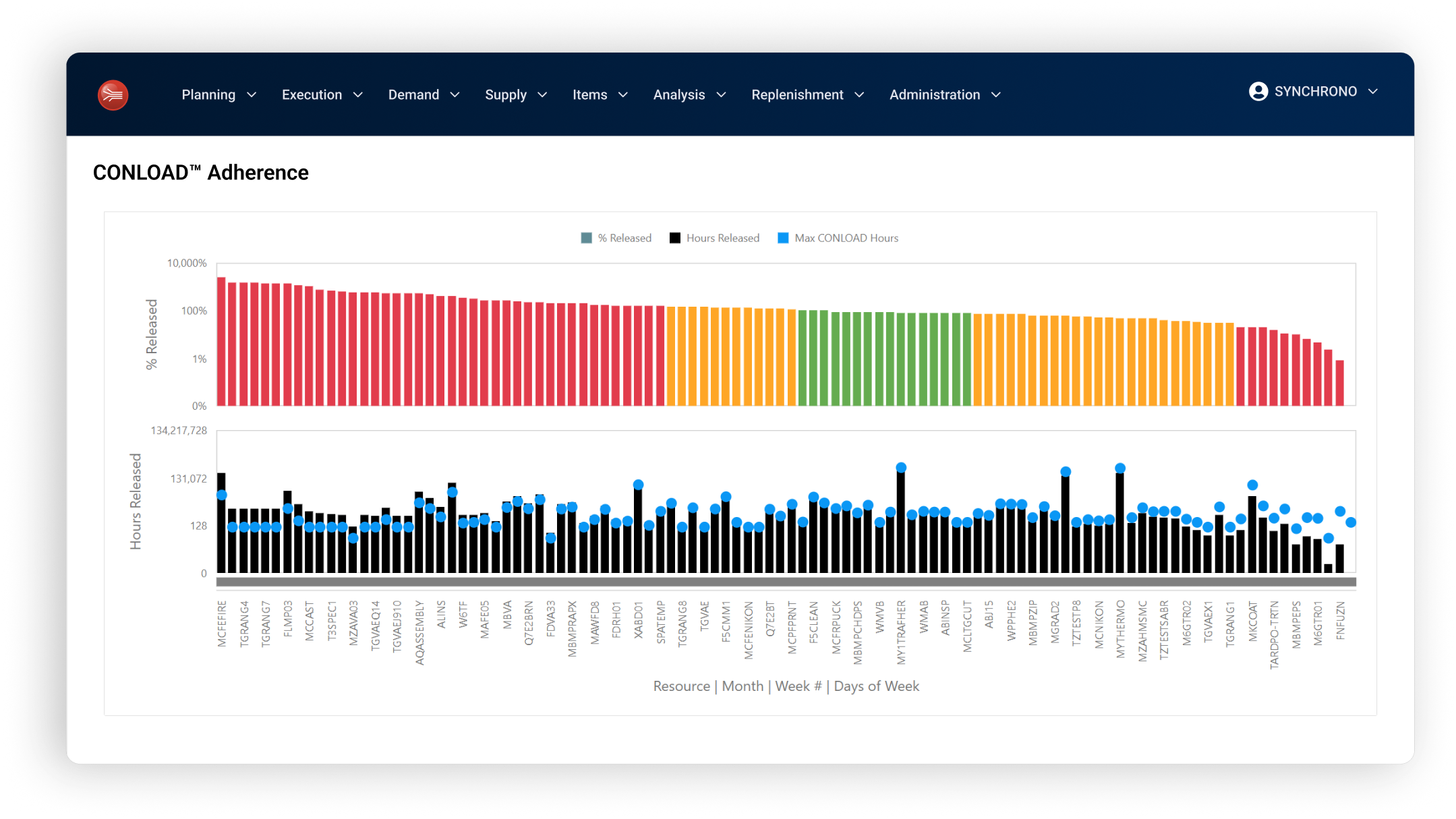
    When the average released load exceeds maximum load, work is essentially being released too soon, which increases WIP, lengthens lead times, and makes completion dates less predictable. By highlighting over-released resources, the dashboard helps teams determine whether execution is out of alignment with company strategy. 

    Who uses CONLOAD™ Adherence?

    The CONLOADTM Adherence dashboard is important for roles responsible for managing constraint resources and overall flow: Operations Managers, Plant Managers, and Master Schedulers. They need to see whether highly loaded resources are being over‑released or under‑released relative to CONLOADTM parameters, because that directly affects synchronization, flow, throughput, and on‑time delivery. 

    Industrial Engineers and continuous improvement leaders are also likely users, since they focus on optimizing constraint utilization and validating whether the modeled CONLOAD™ settings are producing the desired behavior on the floor. By comparing average released load hours to the modeled maximum load hours, they can quickly identify where to adjust planning rules or execution discipline to improve throughput without overloading key resources. 

    How does CONLOAD™ Adherence support Six Sigma or Lean?

    CONLOADTM Adherence supports Lean and Six Sigma by ensuring constraint resources are loaded in line with capacity assumptions to avoid overloading or starving constraint resources. By comparing released load hours to the modeled maximum load hours at each constraint, the metric reveals when constraint‑based rules are being violated and contributing to excess WIP, unstable queues, and longer, more variable lead times. 

    For Lean and Six Sigma teams, the CONLOAD™ Adherence dashboard provides a clear, quantitative way to monitor whether the company release strategy is being followed. When CONLOAD™ Adherence shows chronic over‑ or under‑release, teams can use DMAIC or kaizen to identify root causes, such as lack of training or policy conflicts. 


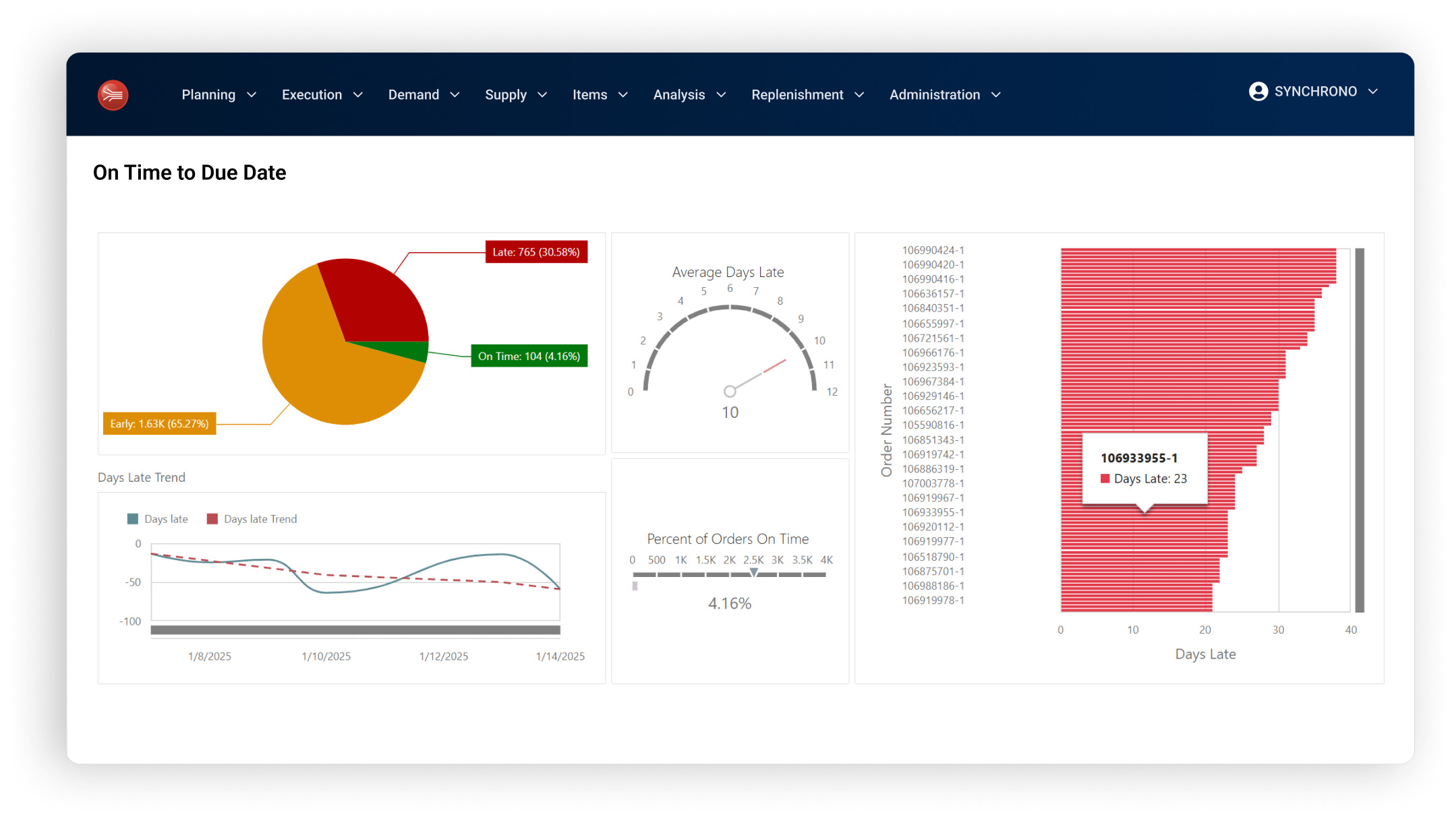
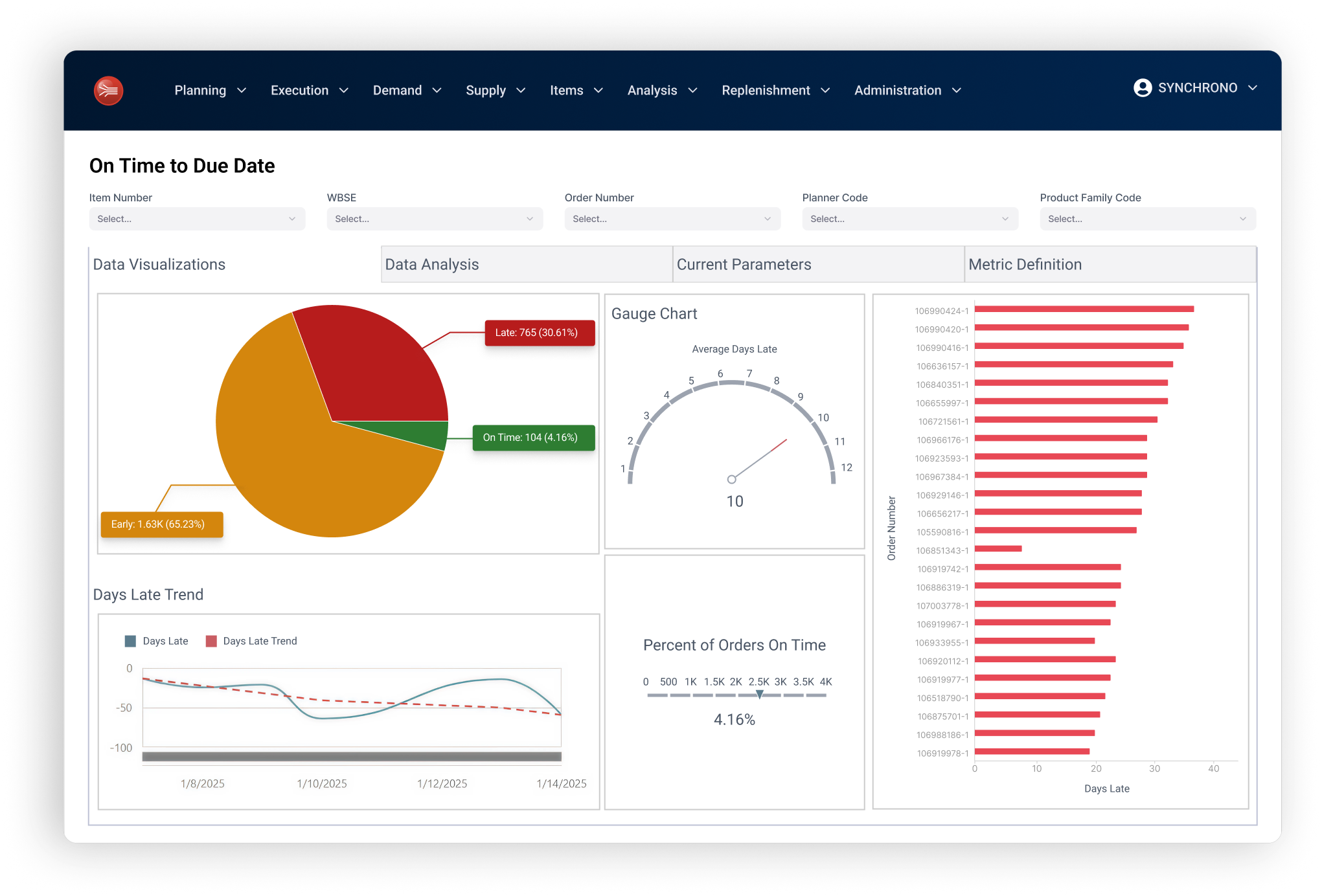
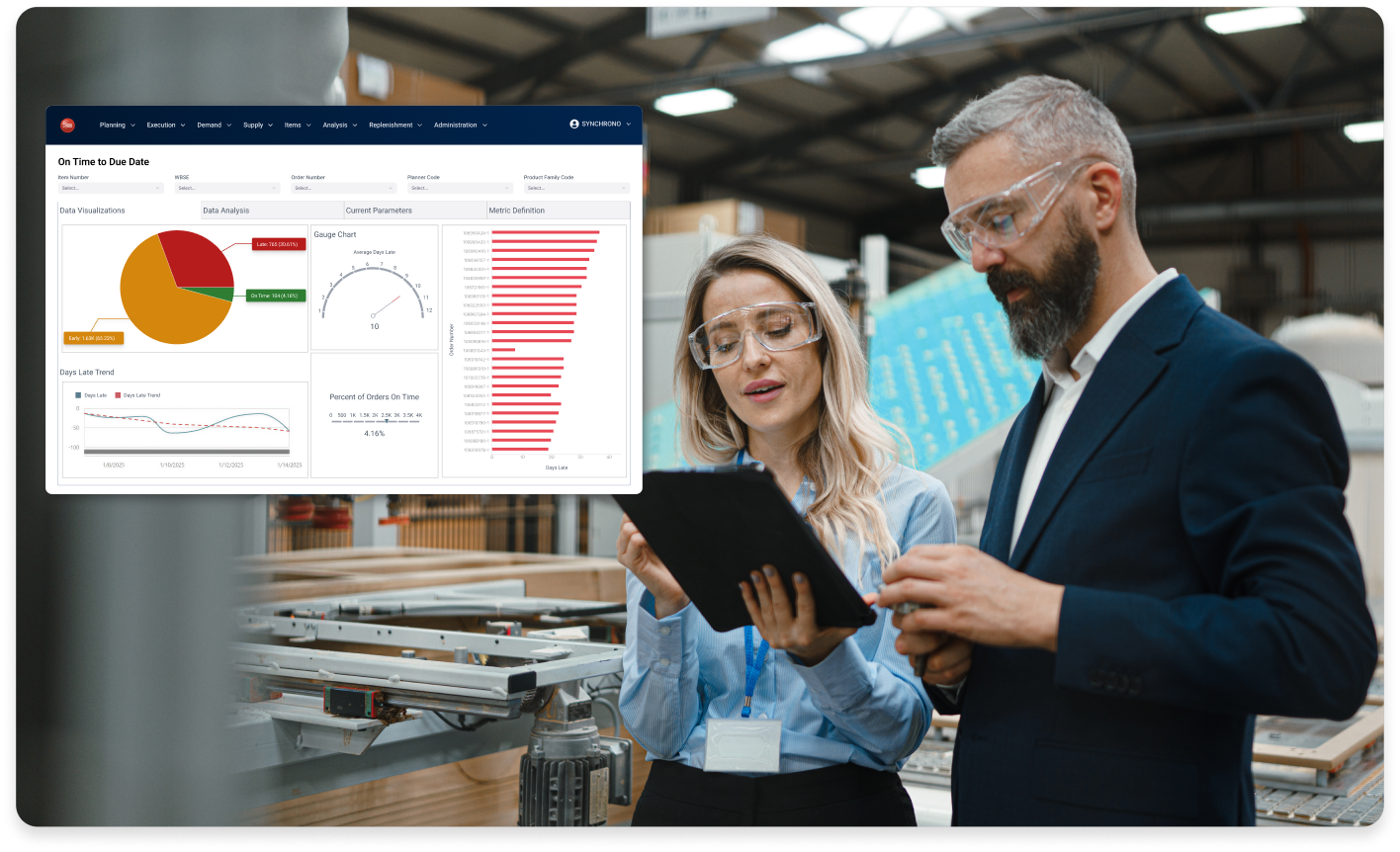
    The On Time to Due Date dashboard provides both projected and historical views of delivery performance, categorizing orders as early, on-time, or late based on a configurable lateness tolerance. The lateness tolerance parameter defines a window around the due date within which an order is considered on-time, allowing manufacturers to align the metric with customer expectations and service-level commitments. 

    Users can analyze open orders based on current projected completion dates and completed orders to assess on-time reliability. Parameters for due-date ranges and tolerance thresholds make it easy to evaluate multiple scenarios and sensitivity to different service-level assumptions. 

    Who uses On Time to Due Date?

    On Time to Due Date is primarily used by Plant Managers, Operations Managers, and VP‑level decision makers who are accountable for on‑time delivery and overall customer service performance. Planners, Master Schedulers, and Customer Service teams also rely on it to monitor current risk to promised ship dates and to prioritize which orders need attention to protect customer commitments

    How does On Time to Due Date support Six Sigma or Lean?

    On Time to Due Date directly supports Six Sigma and Lean because it measures a core Critical-to-Quality requirement: delivering orders when customers expect them. By tracking the percentage of orders that are early, on-time, or late based on the defined tolerance, teams can quantify delivery reliability, a standard Lean/Six Sigma metric often expressed as on‑time delivery rate. 

    In improvement projects, this KPI becomes the primary outcome measure for efforts to reduce lead time, reduce variability, and eliminate waste, such as waiting, rework, and expediting. When On Time to Due Date slips, Lean or DMAIC teams can drill into upstream causes, such as schedule adherence, capacity constraints, or transport delays, and verify that their changes are working as on‑time performance moves toward the target sigma level. 


    The Schedule Adherence dashboard shows how reliably the shop floor is sticking to the priority generated in SyncManufacturing. This dashboard compares the order in which the work is executed as compared with the priority laid out by the schedule. Advanced Planning and Scheduling (APS) solutions are focused on global optimization of operations. Often times resources on the shop floor prioritize local optimization because there is not a clear picture of how their actions impact the flow of the organization. Schedule Adherence measures how well all resources in the operation are supporting global flow and synchronization. It points out where there are conflicts, where additional training is needed, and areas where the organization can improve.  

    Who uses Schedule Adherence?

    Planners, master schedulers, and operations leaders can use this dashboard to monitor day-to-day discipline in following the schedule and to validate whether their release strategies, scheduling methodologies, and overall processes are optimal. With real-time and historical views in a single, visual interface, they can quickly analyze trends to see if there is improvement or decline and the current state to see if there are emerging issues. Improving schedule adherence improves stability, synchronization, and flow, supporting higher throughput and better on-time performance.

    How does Schedule Adherence support Six Sigma or Lean?

     Schedule Adherence supports Six Sigma and Lean by measuring how reliably the plant executes to the production schedule —a core indicator of process stability. High schedule adherence means work priority is followed, which reduces variability and excessive WIP, protects on‑time delivery, and removes a large, controllable source of noise so Lean or DMAIC teams can clearly see where to focus continuous improvement. 

    Understanding Business Health: The Foundation of Continuous Improvement

    Successful, sustainable performance improvement starts with seeing the truth about how your plant is performing—not just at month‑end, but right now—so you can keep your efforts focused on the areas that matter most. With SyncManufacturing V8 BI Dashboards, you gain real-time insight into current performance and trends, making it easier to make sustainable performance gains and quickly course‑correct when conditions change. 

    Contact us for more information or schedule a demo to see how SyncManufacturing BI Dashboards can turn your production data into a practical roadmap for a healthier, more resilient manufacturing business. 

  • Synchrono Releases SyncManufacturing Version 8

    Synchrono Releases SyncManufacturing Version 8

    More Visibility, More Power, More Control for Even the Most Complex Manufacturing Environments

    Synchrono® is excited to share what’s new in SyncManufacturing® Version 8, a release shaped by the real-world challenges and ideas of manufacturers like you. With improved operational visibility, smarter controls, streamlined production planning, a modernized technology platform, and several user-driven enhancements, Version 8 delivers a powerful, more intuitive experience across even the most complex manufacturing environments. 

    Focus on the Metrics that Matter

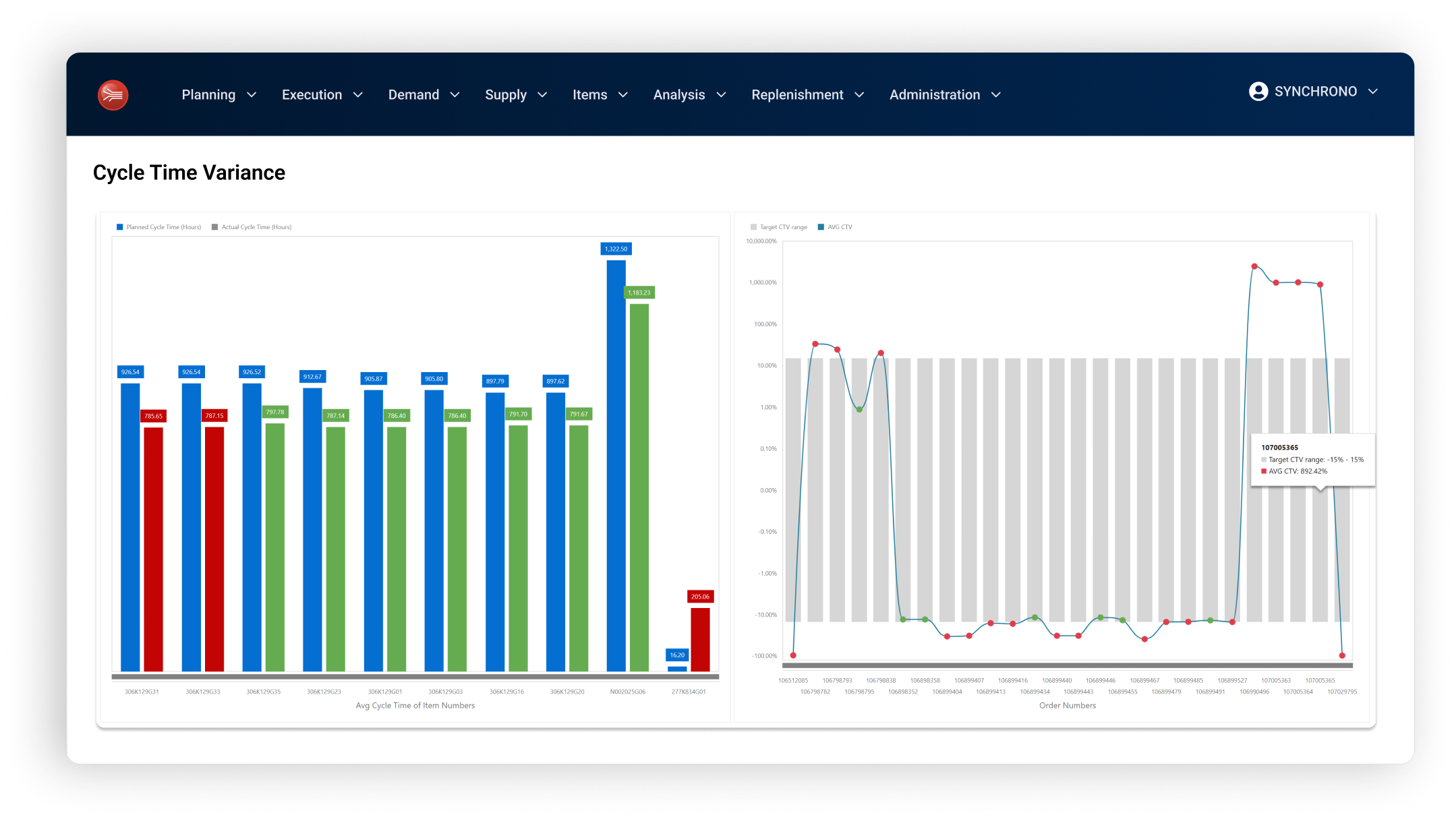
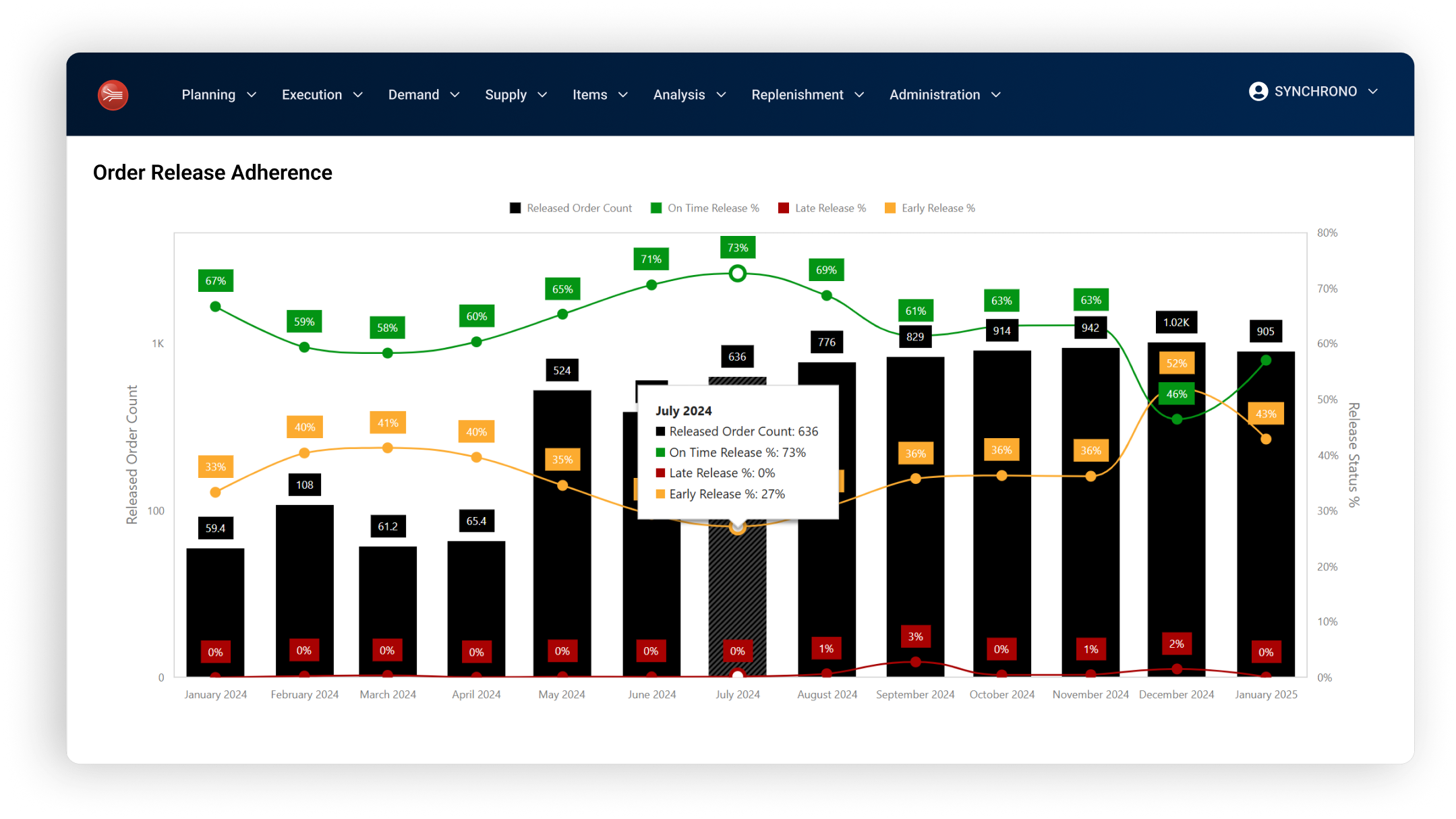
    Version 8 introduces built-in Business Intelligence (BI) Dashboards that turn production data into actionable insights for continuous improvement on the shop floor. Five standard dashboards—Cycle Time Variance, Order Release Adherence, CONLOAD Adherence, On Time to Due Date, and Schedule Adherence—provide an at-a-glance view of how well your operations are performing against plan.​  

    • Cycle Time Variance highlights whether demonstrated cycle times align with planned routings, making it easier to spot inaccurate cycle-time assessments.
    • Order Release Adherence shows how closely execution follows system-generated release dates, a key driver of flow and schedule stability.​ 
    • CONLOAD™ Adherence focuses on constraint resources, comparing average released load hours to modeled maximum load to show when critical resources are consistently over- or under-released.  
    • On Time to Due Date segments orders into early, on-time, or late buckets, and can be viewed either as a forward-looking projection on open orders or a retrospective view of demonstrated performance.​ 
    • Schedule Adherence tracks how well actual production follows the planned schedule, making it easier to spot batching, cherry picking, and chronic variability that undermine flow and delivery performance. 

    These dashboards help teams understand not just what is happening, but why it is happening, and because they are built directly into SyncManufacturing, users no longer need to open a separate tool to view, export, or analyze this data. 

    On Time to Due Date KPI Dashboard
    SyncManufacturing® BI Dashboards share a modern, highly visual design with interactive grids and charts, making it easy to drill into problem orders or resources directly from the same screen.

    Gain Greater Workflow Control

    SyncManufacturing® Version 8 allows users to orchestrate complex workflows as production realities evolve without resorting to offline spreadsheets or manual workarounds.

    Achieve End-to-End Visibility

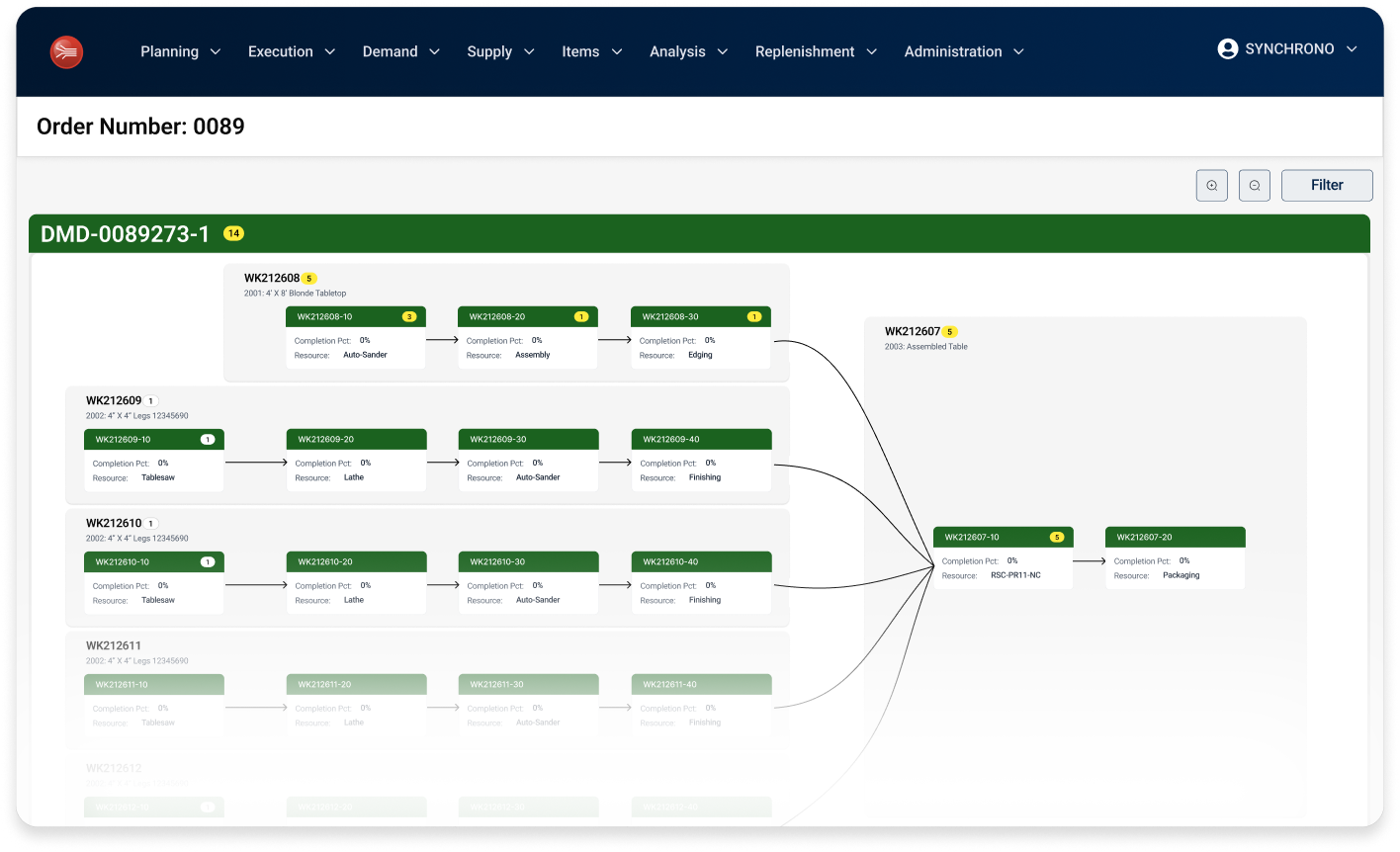
    Multi-level orders can display rolled-up status along with related precedence edges, which is especially valuable in environments with multi-stage assemblies or nested routings. Information on inputs to each operation is accessible through a bottom drawer that opens on demand, giving users the detail they need on material availability and inputs without leaving the main plan view.​ 

    The broadened Network Order Lines capabilities further enhance end-to-end insight by making it easier to understand and manage which orders are tied to which network. From the Network Maintenance screen, the new Network Order Lines view shows existing order lines and lets users add or remove additional ones, tightening control over how complex project or network-based orders flow through the system.​ 

    Supply allocation and detailed sequencing logic benefit from underlying improvements in performance and data handling, including enhanced algorithms and fixes to support pegging in diverse environments. These changes help ensure that when planners evaluate capacity, material, and due dates, the system can respond more quickly and reliably, even under heavy data volumes.  

    Production plan end to end visibility
    Production Plan enhancements give planners a single, interactive view of multi-level orders, networks, and precedents so they can assess inputs, status, and downstream impacts at a glance. 

    Keep Complex Builds in Sync with Supply Allocation

    SyncManufacturing Version 8 introduces Supply Allocation, a new capability that keeps complex, multi-level builds synchronized by directly linking every supply order to the specific demand it serves across all BOM levels. Instead of treating each work order as an isolated record with manually maintained dates, Supply Allocation models the entire build as a single, flowing system so upstream and downstream operations move together. 

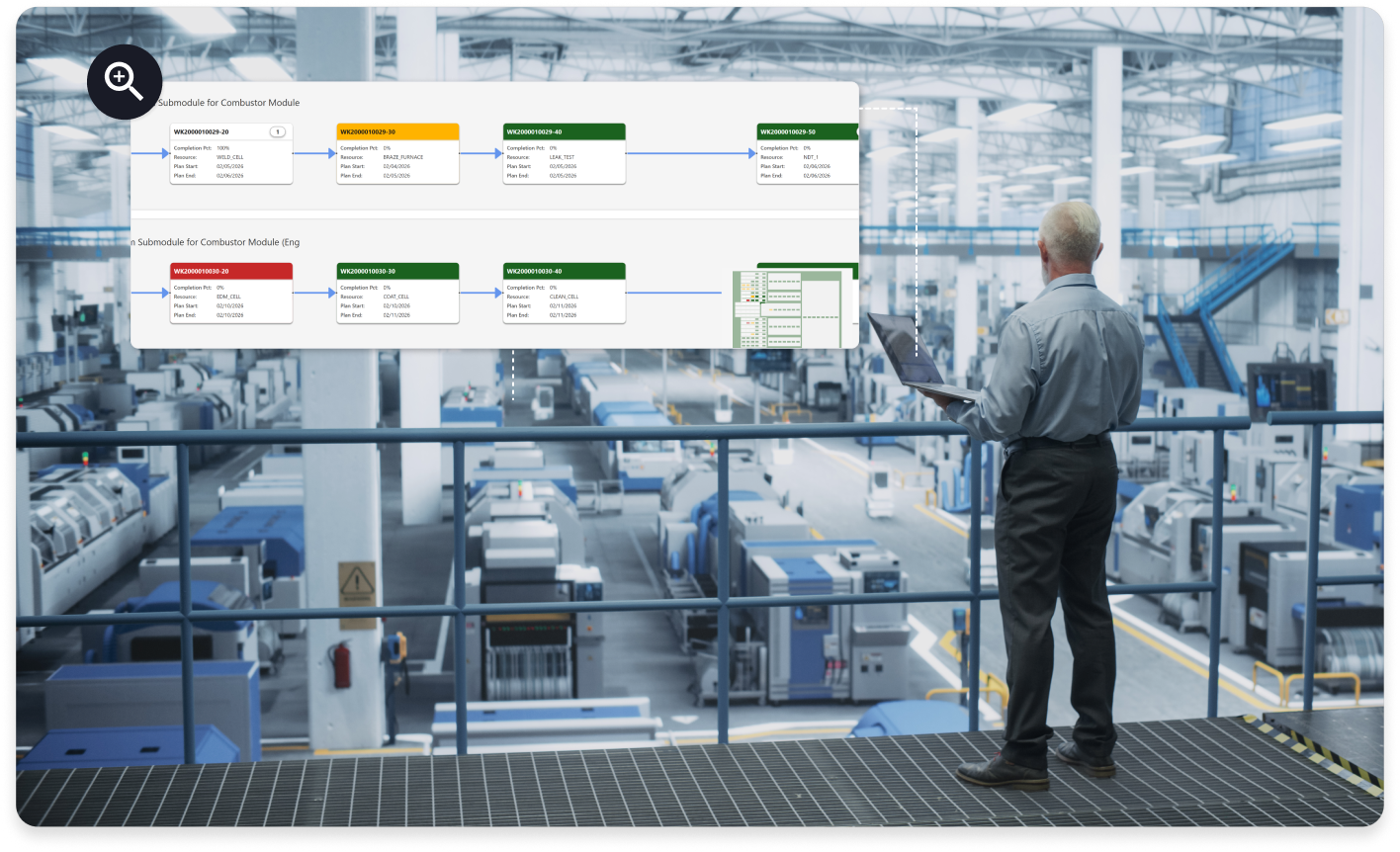
    With these direct linkages in place, every child order “knows” which parent order it supports and how its timing affects the overall build, allowing the scheduling engine to orchestrate the whole structure as one extended process. When conditions change—late material, shifting priorities, or capacity constraints—the impact on the entire order structure is visible in a single, coherent view, and dates are automatically recalculated from the true supply–demand relationships rather than ad hoc due-date resets. 

    The result is a more reliable and efficient operation: supply is tightly aligned with demand so parts always have a clear destination, orders are released to the floor only when they are truly buildable, and planners no longer spend hours stitching together pegging logic across multiple screens and spreadsheets. Organizations gain clearer insight into critical and late paths, reduce stalled work and WIP, and improve on-time delivery by spotting emerging delays early, making Supply Allocation a foundational capability for manufacturers managing deep, multi-level builds in volatile environments. 

    Be Fast & Future Ready

    Under the hood, SyncManufacturing Version 8 delivers significant platform updates that position customers for long-term agility and performance, including upgraded screens for Calendar Maintenance, Group Maintenance, User Maintenance, and other key planning and administration pages.  

    By rebuilding these screens with new UI components, Version 8 provides a more responsive, fluid experience for planners working with complex order structures, calendars, and networks, with faster loading, smoother interactions, and layouts that adapt cleanly to different window sizes and devices so critical information is visible without excessive scrolling or refreshes. For IT and operations teams, the modern component-based architecture is easier to maintain and extend, enabling new visualization, filtering, and workflow features to be introduced more quickly as business needs evolve. 

    The new App Settings page consolidates configuration options and provides centralization that streamlines administration for system owners and implementation teams, reducing the time required to manage settings and improving consistency across environments.​ 

    Performance and stability enhancements appear throughout the application. CONLOAD™ has been optimized, improving performance for constrained-resource planning scenarios, and the Resource Load Report has been reworked to pre-summarize grouped data, align chart and grid values, and better support analysis of completed operations. Numerous refinements—ranging from grid sorting and scrollbar behavior to improved error messages—help deliver a smoother, more predictable experience for end users.​ 

    Key infrastructure components have also been refreshed, including an upgrade for Calendars functionality and new API endpoints to provide clearer status feedback for background jobs. Enhancements to login compatibility messages and new fields like compatible host in plan units ensure users are alerted if attempting to log into incompatible sites, increasing reliability and reducing support overhead.  

    See the New SyncManufacturing® in Action

    SyncManufacturing Version 8 reflects our ongoing commitment to helping manufacturers orchestrate demand, capacity, and flow across increasingly complex operations. From BI Dashboards that spotlight true performance drivers, to advanced precedence management, redesigned production planning, and a faster, more future-ready platform, this release delivers meaningful value for planners, schedulers, supervisors, and executives alike.​ 

    To see how these capabilities can support your specific environment, Synchrono offers live demonstrations that walk through real-world scenarios using the new Version 8 features. Already a customer using SyncManufacturing? Reach out to your Synchrono Consultant to learn more about upgrading.

  • IT/OT Convergence in the Factory of the Future

    IT/OT Convergence in the Factory of the Future

    The convergence of IT/OT

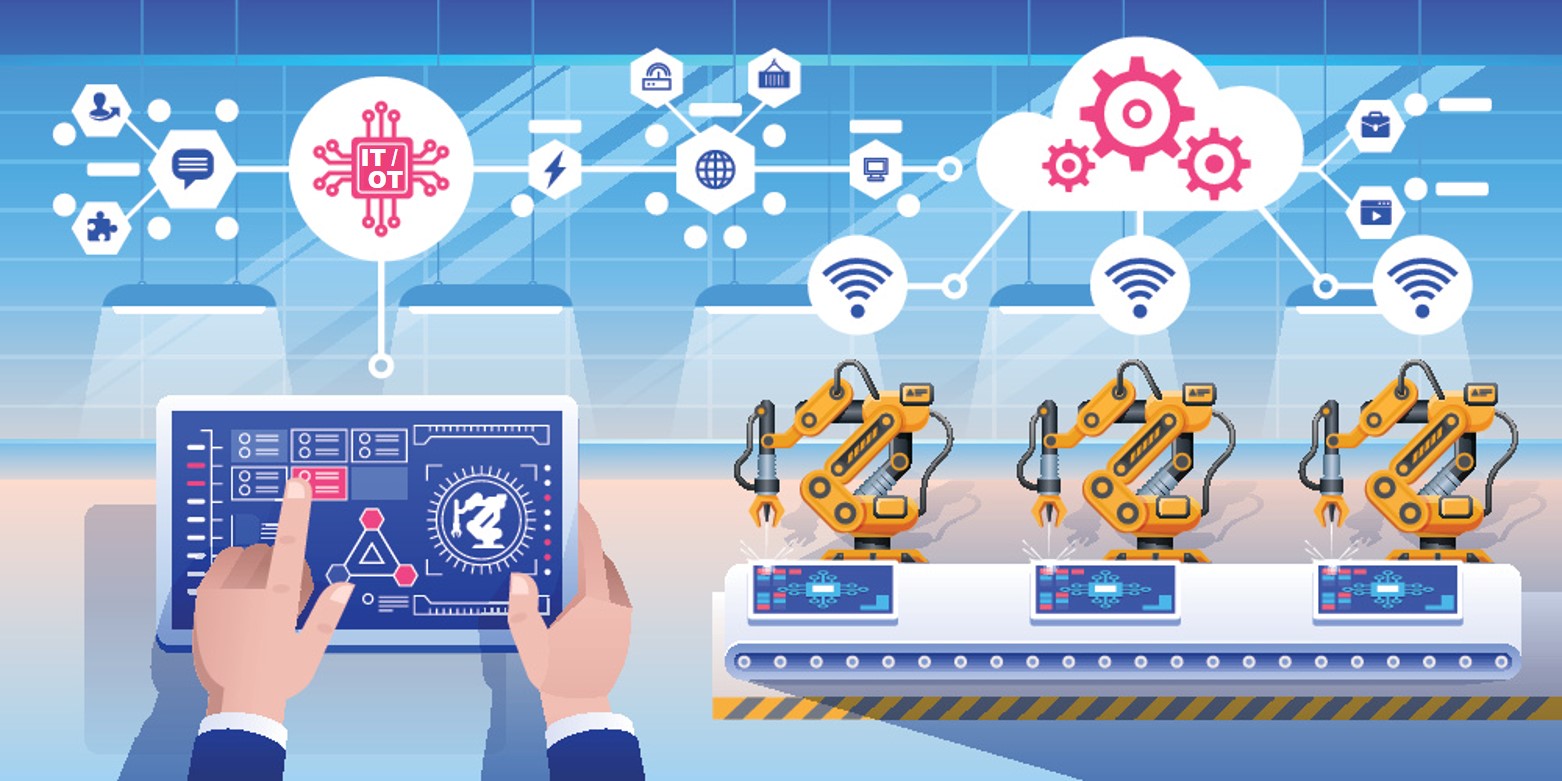
    Since the advent of the Industrial Internet of Things (IIoT), experts and enthusiasts have been talking about the coming together of IT (information technology) and OT (operational technologies). Some call it an integration, while others call it a convergence. I call it a good thing.

    In this post, I’ll talk a bit about the convergence/integration of IT and OT, why it matters, and what it will look like in the Factory of the Future.


    What is IT/OT Convergence?

    WhatIs.com gives a pretty simple, yet solid definition of IT/OT convergence:

    IT/OT convergence is the integration of information technology (IT) systems used for data-centric computing with operational technology (OT) systems used to monitor events, processes and devices and make adjustments in enterprise and industrial operations.

    Other definitions offer variations on the theme. More detailed definitions, for example, might focus specifically on operational technologies such as the billions of connected devices that make up the IIoT.


    What the Definition of IT/OT Convergence is Missing

    Machines talking to each other, seamlessly improving operations without any human intervention. Maybe. Someday.

    In the meantime, the most vital convergence that needs to happen is the coming together of your IT and OT people. To be clear, I’m not talking about the next big trend in organizational restructuring that merges IT and OT teams into one. I doubt most of you would want your IT technicians managing production schedules any more than you’d want your plant managers configuring your network. The skills and knowledge required are vastly different.IT and OT convergence

    What you want to see is the two teams working together to solve problems. In the convergence of IT and OT, each side has something valuable to offer.

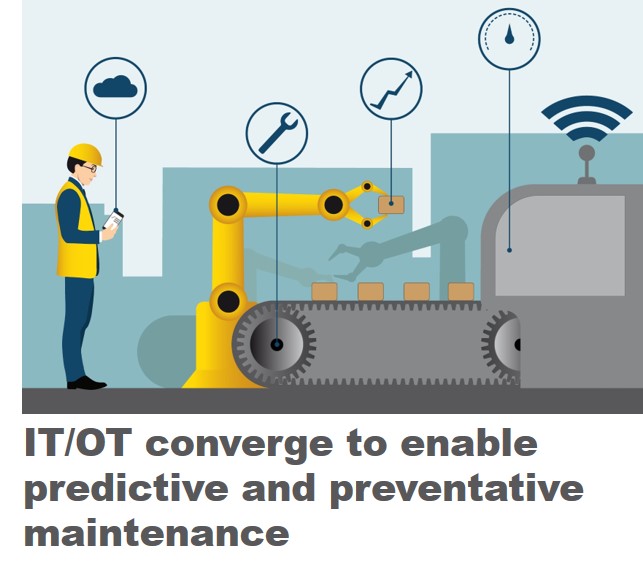
    If you’re in operations, you need the folks in IT to make your ideas work. For example, let’s say you want to implement predictive maintenance in your organization to reduce unplanned downtime. You either purchase or retrofit your equipment with intelligence, and you invest in applications like SyncView® to improve shop floor visibility.

    At a minimum, you’ll need to collaborate with your IT team to make sure that your connected devices (both the shop floor equipment and the handhelds you use to access the real-time information) are secured, so they don’t increase your organization’s cybersecurity risk profile.

    Connecting devices also increases the traffic on your network. IT can be instrumental in ensuring the IT infrastructure is architected to provide the level of performance you require.

    While I don’t imagine there are a lot of IT professionals reading our blog, understanding the benefits of IT/OT convergence from the perspective of the IT professional can help you foster willing collaboration between the two teams.

    CIOs and other high-ranking IT professionals are under increasing pressure to add value to the business through digital transformation. In the 2018 Gartner CIO Agenda Report, 17% of respondents said digital transformation was their number one priority. While 17% may not seem like a large percentage, keep in mind that this 17% ranked digital transformation over other important priorities like profit improvement (10%), innovation (10%), and customer focus (9%). The only priority that topped digital transformation was growth/market share at 26%.

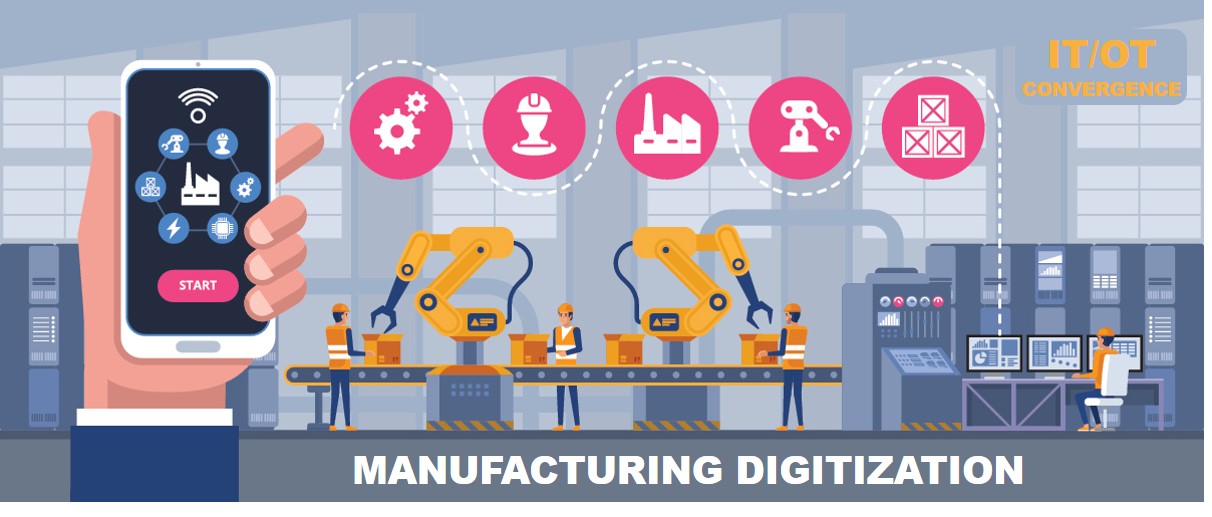
    The challenge for many IT professionals lies in defining exactly what digital transformation means to the organization. It is NOT simply putting more mobile devices in the hands of factory floor employees. For digital transformation to be effective, it must add value to the business.

    manufacturing digitization

    Digital Transformation with a Purpose

    OT professionals can help their colleagues in IT by providing a reason and a method behind their digital transformation initiatives. Take pull-based replenishment as an example.

    In pull-based replenishment, production is tied to customer demand, and materials are only replenished once they are consumed.  While pull can help eliminate many of the eight types of waste identified by Lean Manufacturing, it provides two important bottom line benefits as well: Decreased cycle times and decreased inventory levels. Pull is a vital principle in Demand-Driven Manufacturing.

    8 forms of wasteKanban systems are undoubtedly the most common method for implementing pull-based replenishment. However, manual Kanban systems are fraught with challenges such as human error and lost cards. They can also introduce the waste of excess motion into the system as workers move Kanban cards around the factory floor.

    eKanban replaces manual Kanban with connected devices that send electronic demand signals. No more unexpected stock outs due to a lost or misplaced Kanban card. As an example of how much more efficient eKanban is, consider that one of our customers replaced a manual Kanban process consisting of 66 steps with an eKanban process with only six steps. At the same time, they reduced replenishment inventory by 40% and their lead time from 12 weeks to two.

    Related article: How Demand-Driven Manufacturing Can Help You Cost-Justify Your Next IIoT Project


    IT/OT Convergence IS the Factory of the Future

    In the Factory of the Future, I envision IT/OT planning meetings to be every bit as common as the weekly S&OP meeting is today. That’s because, without the convergence of IT and OT – and the people behind these technologies – the Factory of the Future doesn’t exist.

    Here are a few additional resources that may help as you create your vision for the Factory of the Future and explore how you can bring together your IT and OT teams. (Remember to share these with your colleagues in IT!)

    White papers:

     How Technology will Connect Your Enterprise and Create the Demand-Driven Factory of the Future — Today

     E2E Supply Chain Visibility Technology is Here

    Videos: 

    How Orbital ATK Enabled the IIoT and a Visual Factory 

    Visualizing Metrics in the Factory of the Future 

    Visual Factory Software Overview

    If you have comments or questions on this article or any of the concepts we’ve discussed, please add them below or reach out to me directly.

“test”