Tag: continuous improvement

  • Strategic Prioritization: The Manufacturing Leader’s Guide to Operational Excellence

    Strategic Prioritization: The Manufacturing Leader’s Guide to Operational Excellence

    Manufacturing organizations face an uncomfortable truth: having the capacity to produce something doesn’t mean you should. Every resource allocation decision—from accepting sales orders to scheduling production runs—directly impacts your bottom line. Without strategic prioritization driving these decisions, even the most sophisticated manufacturing operations can spiral into inefficiency, missed deadlines, and diminished profitability. 

    Strategic prioritization extends far beyond simple task management or reactive firefighting. It represents a fundamental shift toward aligning every organizational function with your company’s core objectives. When implemented effectively, strategic prioritization becomes the driving force of your manufacturing operation, ensuring that sales, engineering, procurement, production, and logistics work as a cohesive team. 

    The stakes couldn’t be higher. Discrete manufacturers operating in today’s competitive landscape cannot afford misaligned priorities. Resource constraints and material availability limitations mean that every decision carries significant consequences. Organizations that master strategic prioritization gain sustainable competitive advantages, while those relying on ad hoc approaches face mounting operational challenges. 

    Understanding Strategic Prioritization in Manufacturing 

    Strategic prioritization means every person in your organization works toward the same objectives—objectives that directly align with your company’s vision and goals. This alignment creates a powerful multiplier effect where individual efforts combine to drive exceptional organizational performance. 

    The foundation begins with executive leadership establishing a clear vision and objectives based on core values. However, translating high-level strategy into daily operational decisions requires a systematic approach. Strategic prioritization serves as this critical translation mechanism, filtering every function and process through your strategic lens. 

    Manufacturing environments demand particular attention to this alignment. Sales teams must understand which products generate the highest strategic value, not just the highest commissions. Production managers need clear guidance on which orders deserve priority when capacity constraints force difficult choices. Purchasing departments require strategic direction to optimize supplier relationships and inventory investments. 

    three manufacturing employees arguing looking at screens

    The Hidden Costs of Manual and Ad Hoc Prioritization 

    Local Optimization Challenges

    Imagine a manufacturing manager overseeing an operation ten levels deep in a complex product structure. Their ad hoc priority decisions directly impact downstream production capabilities. While they may achieve excellent utilization metrics in their area, their decisions might create bottlenecks and delays at points downstream operations that compromise overall system performance. 

    Expert knowledge within specific areas doesn’t translate to understanding complex organizational interdependencies. The more sophisticated your manufacturing processes, the more these local optimization decisions can undermine strategic objectives. 

    Systemic Consequences

    1. Understanding Organizational Relationships

    Document relationships between activities required to complete orders. Manufacturing organizations use value stream mapping, process mapping, SIPOC diagrams, swim lane diagrams, and dependency structure matrices to capture these relationships. 

    Understanding precedent relationships enables accurate propagation of order due dates throughout all related activities. Without this understanding, synchronization becomes impossible. 

    2. Constraint Analysis Implementation

    Organizational relationships create networks of activities and interdependencies. Understanding these networks enables the identification of resources and processes constraining productivity. Focusing improvement efforts on these constraints delivers sustainable growth and enhanced profitability. 

    Theory of Constraints (TOC) provides an excellent framework for constraint analysis and management. While most commonly associated with manufacturing, TOC applications extend successfully to project management, supply chain management, marketing, and engineering operations. 

    The TOC process follows five steps: 

    1. Identify system constraints 
    2. Exploit constraint capabilities fully 
    3. Subordinate all other activities to support constraints 
    4. Elevate constraints through capacity improvements 
    5. Repeat the process for continuous improvement 

    Step two, exploit the constraints, directly relates to strategic prioritization. Constraints represent critical resources where time invested in non-strategic activities represents permanent losses. Constraints must work in strict priority order aligned with organizational objectives. 

    Step three, subordinate all other activities to support constraints, is about bringing all other activities within the company in alignment with strict priority established at the constraints. 

    3. Tie-Breaker Mechanisms

    Due date prioritization inevitably creates conflicts when multiple orders require the same critical resources simultaneously. Organizations typically establish customer, program, or product priorities using classification systems. Government contractors may receive mandatory priority designations for specific programs. 

    Regardless of your tie-breaker methodology, two requirements must be met: 

    • Methods must align with strategic organizational priorities 
    • Planning and scheduling systems must incorporate priority information into scheduling logic 

    Priority doesn’t mean production sequence. Higher priority orders receive preference for on-time performance when resource conflicts occur. Planning and scheduling systems unable to incorporate non-date priority information will be bypassed, creating disconnected manual and ad hoc systems. 

    4. Systems Integration Strategy

    Activities required to complete orders often occur in disparate systems. These systems require tight real-time integration to accurately propagate priority throughout all activities. Every system should reflect identical priorities. 

    Systems difficult to integrate represent candidates for replacement, especially considering AI capabilities requiring access to comprehensive, timely information. Modern manufacturing environments demand seamless information flow between all operational systems. 

    5. Organizational Visibility 

    From executive boardrooms to production floors, all employees must work toward identical goals. Regardless of the systems employees use, priorities must be highly visible and easily understood. 

    Systems failing to accurately synchronize activities with organizational priorities should be replaced. Interactive dashboards can sometimes overcome system limitations by embedding priority logic into visual displays. However, tightly integrated systems remain necessary for comprehensive implementation. 

    two manufacturing professionals looking at a computer smiling

    Implementation Strategy for Manufacturing Leaders 

    Strategic prioritization implementation requires systematic change management addressing both technological and cultural dimensions. 

    Executive Commitment: Leadership teams must demonstrate unwavering commitment to strategic prioritization principles. This commitment includes making difficult decisions that prioritize long-term strategic value over short-term local optimization. 

    Technology Infrastructure: Evaluate existing systems for integration capabilities and real-time information sharing. Identify systems requiring replacement or significant upgrading to support organization-wide prioritization requirements. 

    Training and Development: Employees at every level need training on strategic prioritization principles and their role in organizational alignment. This training must extend beyond manufacturing to include sales, engineering, and support functions. 

    Measurement and Continuous Improvement: Establish metrics measuring prioritization effectiveness. These metrics should track alignment between activities and strategic objectives and achievement of organizational goals. 

    Driving Sustainable Manufacturing Excellence 

    Strategic prioritization transforms manufacturing organizations from reactive firefighting operations into proactive, strategically aligned enterprises. When every decision aligns with organizational objectives, the cumulative impact drives exceptional performance improvements. 

    Manufacturing leaders implementing strategic prioritization frameworks position their organizations for sustained competitive advantage. Resource constraints become optimization opportunities and leverage points rather than limiting factors. Complex manufacturing processes operate in harmony rather than creating internal conflicts. 

    The time for implementation is now. Manufacturing becomes more competitive each day, and organizations that gain strategic prioritization advantages will be increasingly difficult to match. Begin by assessing your current prioritization approaches, identifying improvement opportunities, and developing systematic frameworks for organizational alignment. 

    Your manufacturing operation’s future depends on strategic prioritization excellence. The question isn’t whether you can afford to implement it, it’s whether you can afford not to. 

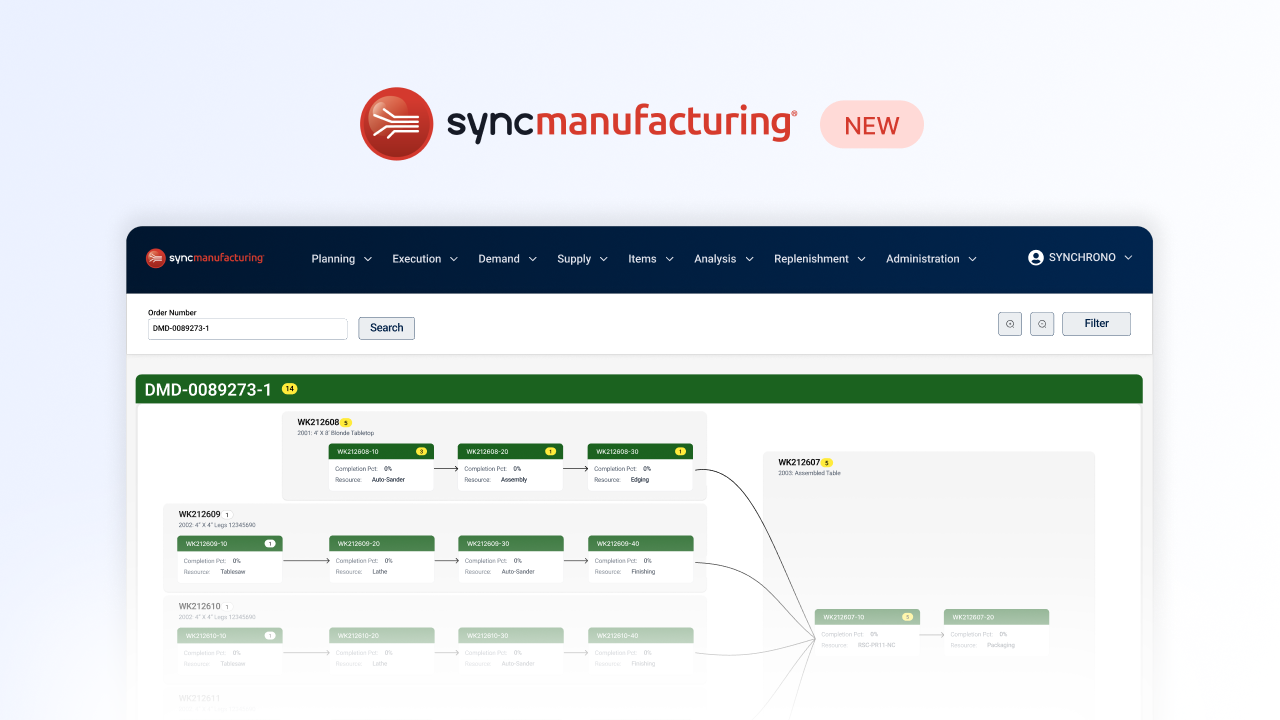
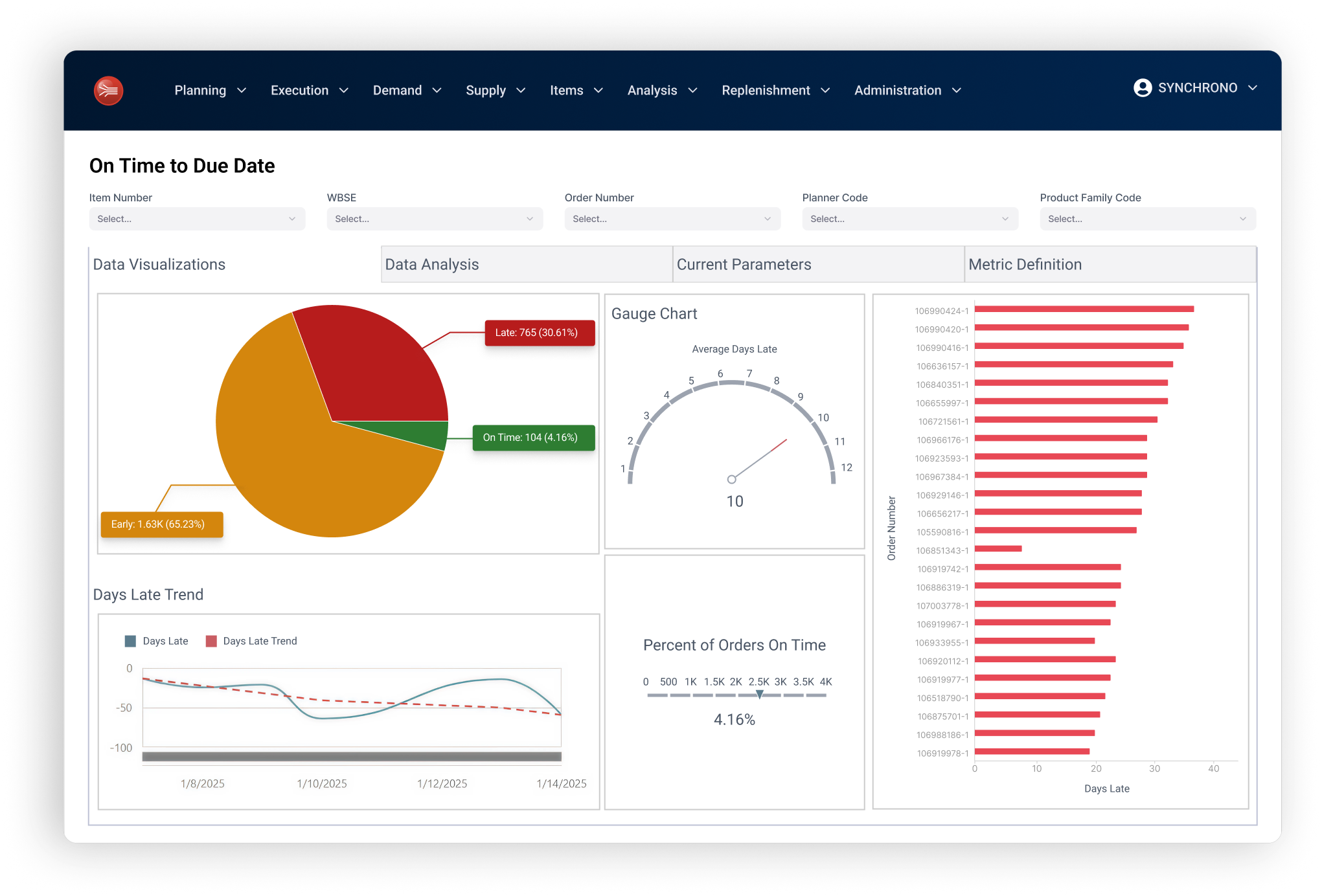
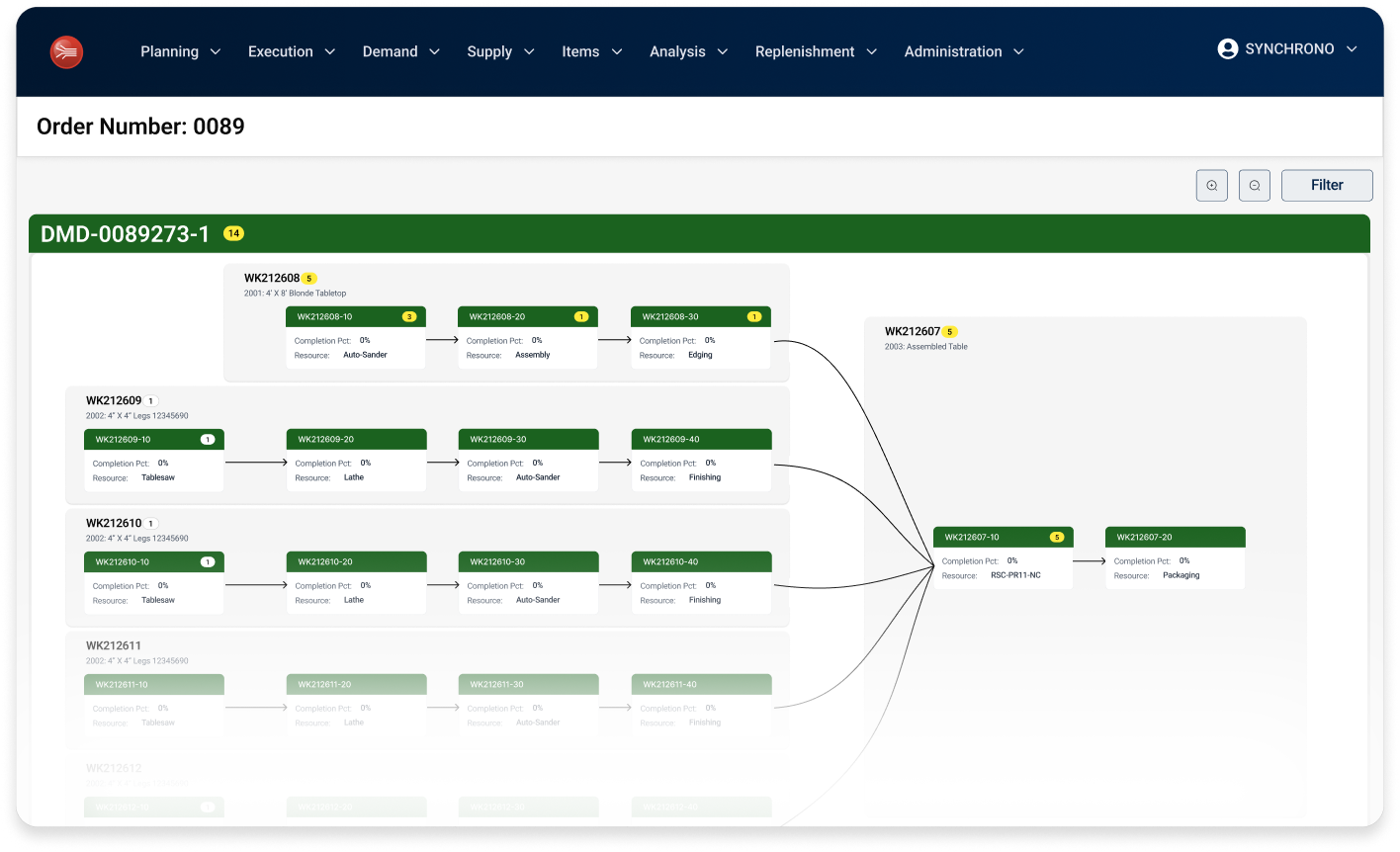
    See how SyncManufacturing® incorporates business priority information into planning and scheduling by requesting a demo.

  • Solving Wood Products Planning and Scheduling Challenges with Master Item Planner 

    Solving Wood Products Planning and Scheduling Challenges with Master Item Planner 

    Table of Contents

    Manufacturing wood products is not for the faint of heart. As if seasonal and economy-based demand variability weren’t enough, working with organic raw materials such as wood inherently leads to manufacturing process variability. Skilled workers and robust processes are needed to ensure sustainable operations despite thin margins in this highly competitive market.   

    This post explores the manufacturing challenges faced by wood products manufacturers and shows how SyncManufacturing® and the Master Item Planner module address these issues.  

    Wood Products Manufacturing Challenges

    If you’re a production scheduler in the wood products industry, you know how challenging your role can be. No matter what the Master Production Schedule produced by your ERP system says, you no doubt spend hours adjusting schedules to real-world constraints, such as the quantity and quality of raw materials available, current workforce skills and availability, and the inevitable supply chain delays. Despite all your efforts, your production schedule can become instantly obsolete when things change, such as discovering that one of your raw materials shipments wasn’t up to the promised quality standards. 

    But the wood products production planner’s challenges do not stop there. As an example, take the challenge of manufacturing engineered wood products such as an LVL beam. LVL, short for laminated veneer lumber, is manufactured as a large panel often referred to as a “billet.” This panel is then cut lengthwise to achieve the desired height of the final product before being trimmed crosswise to the required length. Twenty or more finished products can be cut from one billet. The production planner’s challenge becomes how best to fulfill customer orders while minimizing material waste and maximizing plant capacity.   

    4 Steps to Minimizing Waste and Maximizing Resource Utilization


    Roseburg Forest Products logo
    Ryan West, Scheduling and Optimization Manager, SIOP at Roseburg Forest Products

    4 Benefits of Master Item Planner

    Master Item Planner helps wood products manufacturers optimize their operations and achieve greater productivity and production efficiency. Let’s dig a bit deeper into these key benefits.  

    Minimize material waste – By evaluating all possible options, the Master Item Planner creates a low-waste plan that ensures materials are used most effectively. The Master Item Planner can also be configured to meet the needs of individual facilities, such as prioritizing filler products based on historical demand, preferring certain billet lengths, or focusing on full bundle or unit sizes of finished products.  

    Maximize plant productivity – Because the Master Item Planner creates electronic work orders and aggregates customer demand into stock order suggestions, plant productivity can be calculated and forecasted. Instead of booking to approximations of capacity, like linear or cubic feet, SyncManufacturing can direct the sales team to book new orders directly against machine hours.  

    Increase production efficiency and agility – Instead of manually determining plans using spreadsheets and institutional knowledge, the Master Item Planner can calculate a plan in seconds. The time difference between tweaking a pre-made plan and manually creating a plan from scratch is significant. Automated production scheduling software also allows the business to be more responsive to last-minute rush orders from customers.  

    Improve workforce utilization and retention – Hiring and retention issues frequently come up in our discussions with customers. Production schedulers and planners are often seasoned employees with a lot riding on how well they perform their role. Standardized, automated production scheduling processes reduce burnout by making the planning and scheduling roles less stressful and making it easier for others to fill in. Standardized processes can also make it easier to onboard new people when current staff members retire.  

    See Master Item Planner in Action

    We’re excited to introduce the Master Item Planner module within SyncManufacturing® and would like to thank Roseburg Forest Products for their support throughout the development process. Based on their input, Master Item Planner continues to maximize the value, such as reducing waste and maximizing manufacturing efficiency and productivity. For more information and to see the Master Item Planner in action, schedule a demo with one of our specialists.  

  • The Best Time to Kick Off a Continuous Improvement Initiative

    The Best Time to Kick Off a Continuous Improvement Initiative

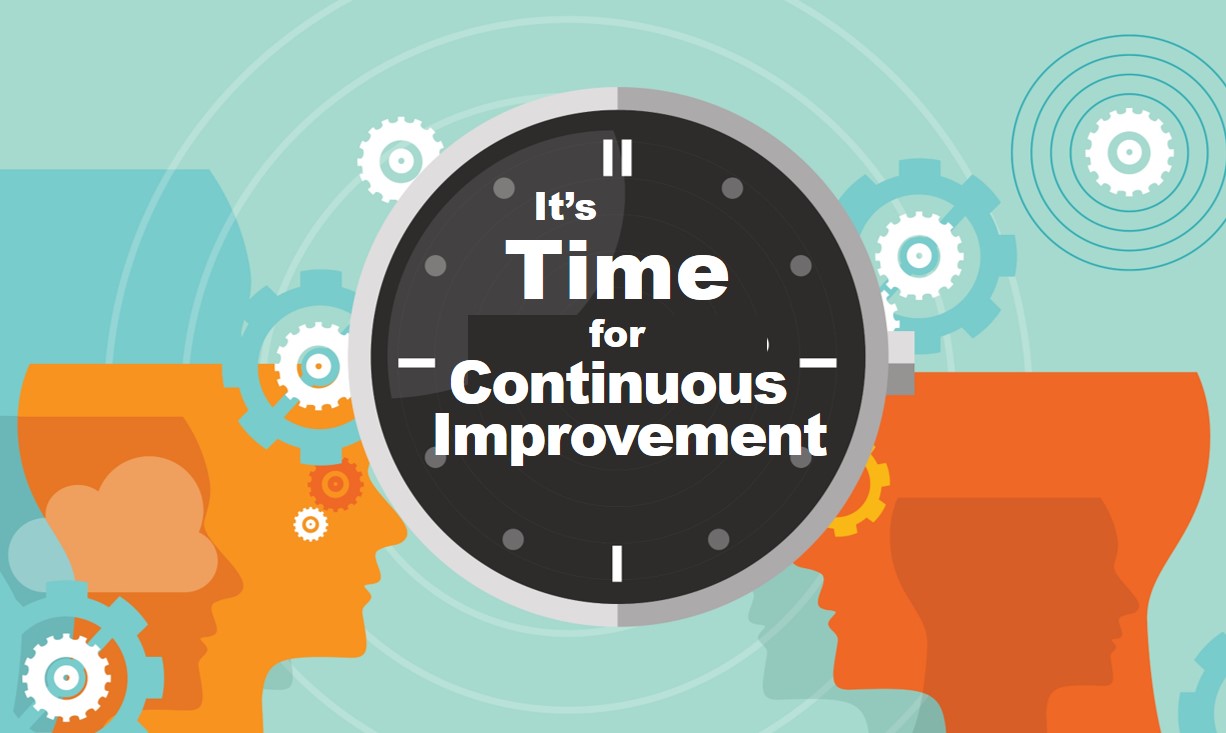
    It's Time for Continuous Improvement

    Prosperity is perhaps one of the greatest obstacles to continuous improvement in manufacturing. When things are going well, we don’t feel the need to make improvements quite as keenly. For example, instead of focusing on removing waste in our factories to become more cost competitive, we might opt to add capacity so we can keep up with demand.

    There really is no better time to make improvements than when things are going well. In this post, we’ll take a quick look at what the research says about the short-term outlook for manufacturers. Then, I will explain why now is the best time to kick your continuous improvement efforts into high gear.


    Things Are Looking Up

    Manufacturing outlook

    After nearly a decade of belt-tightening, many sectors are returning to a renewed sense of optimism. This is especially true in manufacturing. An amazing 93.5% of respondents to NAM’s 1st Quarter 2018 Manufacturer’s Outlook Survey registered a positive outlook, the second highest level recorded in the survey’s 20-year history.

    Of course, because NAM is reporting on human sentiment, there’s always the chance that their results aren’t indicative of what’s actually happening in the market. Humans are not always the most objective source of “data.”

    MAPI (Manufacturer’s Alliance for Productivity and Innovation) looks at a number of variables to project growth rates for the manufacturing sector. In March of this year, they nearly doubled their projected average growth for the U.S. manufacturing sector for the 2018-2021 period from 1.5% to 2.8%.

    It’s not that you can’t find anyone who thinks things are not as rosy as they seem, but much of the negativity stems from a concern that the economy will grow too fast. That sounds to me like what an old colleague of mine in the manufacturing sector used to call “a happiness problem.” For now, most manufacturers I know are just trying to make the most of the opportunity presented to them.

    Continuous Improvement Projects

    Optimistic Workers Make the Best Change Agents

    As anyone who has ever tried to implement a continuous improvement effort knows, the more secure your shop floor workers feel, the more likely they are to support change. While neither the NAM survey or the MAPI analysis look at worker sentiments, there’s no doubt that the optimism at the top has a way of filtering down.

    Consider these two very different scenarios:


    Scenario A: The Mandate to Cut Costs

    A machinist has just stepped out of a company-wide meeting in which executives issued a cost-cutting mandate due to a slowdown in orders. With support from the COO, production managers decide the best way to cut costs is to lower inventory levels by implementing constraints management.

    Now they need to explain it to the machinist and other team members in similar roles.

    What the operations manager says: “We’ve identified the painting station as the constraint in our operations, so we’re going to set the pace of production to maximize capacity at that station. We don’t want you working on anything other than what the system tells you to. This may mean you have more downtime, but that’s OK. We’re not measuring utilization rates right now.”

    What the machinist hears: “We need to cut costs, so we’re going to cut back on production. We know you’ve been making more than you needed to anyway. You’ll probably have more idle time because we won’t always have enough work to keep you busy.”

    During one of those idle times, the machinist starts to wonder how long it will be before the cost-cutting measures include his job.


    Scenario B: Let’s Pick Up the Pace!

    This time, the company meeting is about increasing the pace of manufacturing. The sales pipeline is fuller than it’s been in a long time, and sales believes that if the company can decrease lead times they’ll be able to have a banner year and increase market share.

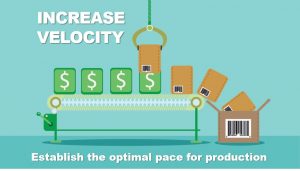
    Increase velocity

    Once again, the operations managers decide to implement constraints management. This time the focus is on increasing velocity.

    What the operations manager says: “We’ve identified the painting station as the constraint in our operations, so we’re going to set the pace of production to maximize capacity at that station. We don’t want you working on anything other than what the system tells you to. This may mean you have more downtime, but that’s OK. We’re not measuring utilization rates right now.”

     What the machinist hears: “Business is good, but we need to determine how to step up our pace. We’re going to try this thing called constraints management. It will seem a little strange at first, but it’s all part of the process.”

    In this scenario, the machinist does some reading on Lean and attends a few workshops during his downtime. Instead of worrying about his future, he starts to think about how he might contribute to the initiative. Maybe he’ll even work to become a green belt and advance in his career.


    Making Hay While the Sun Shines

    Nothing lasts forever, and that includes a great economy. The continuous improvements you implement now can set you up to weather the hard times ahead with both better processes and better people. The sun is shining on much of the manufacturing sector. Now is the time to take advantage of it.

    In this post, I focused on constraints management, but there are many other types of continuous improvement initiatives. If you’re still defining your approach, we have plenty of resources you can mine for ideas. Here are just a few.

    Paper: 4 Ways SyncKanban eKanban Technology Drives Continuous Improvement

    Paper: Get Lean on Scrap

    Post: How the Internet of Things Can Shorten Lead Times

    Post: How the Internet of Things Can Help Lower Inventory Levels

    Video: How Orbital ATK is Leveraging the IIoT and Visual Factory Technology to Drive Continuous Improvements

    Post: Turn Your Gemba Walk Into a Power Walk

    For additional ideas, visit our Resources page on our website.

  • Three Ways Leaders Create Lean

    Three Ways Leaders Create Lean

    Three Ways Leaders Create LeanThree Ways Leaders Create Lean

     “Relentless” leadership and team empowerment drive lean change

    For those of you who have heard this before, it bears repeating. For those of you who have not, this is important – leadership is the single most important component to lean success. 

    It is exciting to talk about bottom-up change and expect that a ground swell of individuals in virtually every level of the organizational chart can succeed with lean—in spite of those in the C-suite that just don’t get it. But in practice, this has to happen early on or there is little-to-no chance of success.

    Who’s driving this thing?

    I am not saying that lean changes cannot start from the bottom-up; but the situation needs to flip quickly to leadership driving the bus. That’s because at some point early on in your lean journey, your methods will start to conflict with some long-standing processes and metrics. These formerly sacrosanct topics need to be addressed by leadership (those with the power to change them) before your journey can continue.

    Once leadership is on board, the leader(s) can come from anywhere in the company.  But to prevent stagnation at a higher level, leaders must carry the torch of continuous improvement tirelessly and relentlessly.

    80/20 rule

    They can start out leading the kaizen events but they need to mentor and train those doing the work in order to keep continuous improvement alive and well.  Mature lean organizations expect 80% of their improvements to come directly from those closest to the work.  This is the only way to fully utilize the talents and capabilities of your human assets.  Give the people closest to the work the tools and the support necessary to astound you with their creativity and innovation.

    Out on the floor

    Gone are the days where leaders sit in their offices sending out directives to the rest of the organization and lead mainly by pounding on the rest of us when those directives are not met. Today, leaders are responsible for training and mentoring their people. They equip them with the tools of continuous improvement and empower them to remove the obstacles that block their way.  Here are some ways I have seen manufacturing leadership create a more demand-driven culture:

    • Of machines and men (or women) – Leaders who think of their production staff as extensions of their equipment are making a fatal error. Empowered people who feel their bosses care about keeping them on staff by growing their skills and offering development opportunities are the people who will drive the changes needed to make your business excel.
    • “Scaffolding” support – It is a huge mistake to treat your people like their only role is to follow the standard operating procedures (SOPs) handed down from above and that the only way they drive value is when their direct labor hours are being absorbed into products. You are under-utilizing the most valuable assets in your organization.  It doesn’t happen overnight and without any effort, but you must build the scaffolding needed to support your people by giving them the tools, confidence, and authority to make changes.  It is the people closest to the work – and who know the most about the process – that can provide the greatest innovation if you build the foundation on which they can innovate.
    • Training rolls on- Training should never stop. I hear the complaints and the unending list of obstacles – no time, no budget, where to begin, no senior-level support, and so on. But every moment spent training your people yields ongoing hours saved in fixing mistakes, putting out fires and trying to explain your poor results to the powers that be. Equip them with the tools, confidence, and abilities to speak up when something’s wrong; show them how to look for solutions and take ownership of results, and you are tuning up the “true improvement machine” on your shop floor and beyond.


    I have been working with supply chain professionals and manufacturing leaders my entire career. If there is one thing I can say about the successful ones, it’s this: Effective change agents in manufacturing environments invariably spring from a leadership culture that supports the people not just the change — every step of the way.


    – John Maher


    John Demand-Driven Matters                                                                                                                                                                                                                                                                                                           John’s passion for demand-driven manufacturing is equal to his interest in how this method improves the lives of employees within these environments. “I’m here to help, not to judge” comments John whose posts reflect why demand-driven matters and are based on his experience working in manufacturing environments and expertise in ERP, MRP, APS, supply chain, manufacturing planning and scheduling systems and constraints management.
  • Fast Results Using TOC for Demand-Driven Manufacturing – Part Two

    Fast Results Using TOC for Demand-Driven Manufacturing – Part Two

    sandpaper-153235_1280Manufacturers use constraints management first to gain the most demand-driven change

    Last time, we talked about focusing on enterprise improvements rather than local efficiencies using constraints management (TOC). We discussed that continuous improvement tools such as TOC, Lean and Six Sigma work like “sandpaper” on an organization’s processes, smoothing various stages of their demand-driven journey.

    I likened TOC to the “coarse” grit of sandpaper—the one to use first to get the best results–faster. Before discussing the other tools (which I’ll address in future articles), I wanted to share how the TOC principles we discussed last time have brought real results to two manufacturers.

    Constraints management improves throughput, on-time delivery, more

    My first example, a discrete manufacturer of test equipment for semi-conductors, decided that they could do better and that TOC was going to be the philosophy they utilized to do it.  They had a lot of difficulty in production and in meeting their client requirements.  They began by implementing drum buffer rope (DBR) scheduling.  As part of this, they identified a drum for the organization and began managing it as the constraint.  It is important to note that TOC people do not regard constraints as bad things per se, instead, they look at them as leverage or control points that allow you to simplify management of your system.  There are many people that I come across who think TOC is about identifying and eliminating constraints.  However, Goldratt viewed constraints as a positive item in that in an interconnected environment, the constraints provided the leverage points that greatly simplified management of the system.   Goldratt once told me that the constraint within an organization should not move any more than once every two to three years.

    Once the drum was identified, the next steps were to exploit the constraint and subordinate all other resources to the constraint.  As part of this, the company identified a number of policy and process changes. First, they changed what they did when a constraint resource needed a first-article inspection before continuing to run. They began moving the parts requiring inspection to the front of the queue and, in some cases, removing parts from the test equipment in the middle of the test, in order to service the constraint faster. Soon, the team carried this first-in-line mentality throughout the organization with a laser-like focus on clearing anything that got in the way of the constraint producing to current customer demand. Here are their results:

    • Increased constraint throughput by 120%.
    • Increased on-time delivery from low 70% to 95%+.
    • Cut cycle time and lead-time in half.

    Before this change, the company was outsourcing 50% of the work for the constraint. They have since brought it all in house where the yields were much higher, plus, they added another 20% of throughput.

    All of this was accomplished within four months and without making one physical alteration to production.  No 5S, no kaizen events, no SMED, no value-stream maps, no re-laying out of the production process, no Six-Sigma projects.  Also, no additional people or capital equipment were needed.  The tools of Lean and Six-Sigma were critical to continuous improvement and refinement of the process, but Constraints Management (harkening back to the sandpaper analogy) served as the coarse sandpaper, taking a rough board and making the dramatic change of smoothing it out.

    60% on-time delivery to 90+

    Another example – During my work with a discrete manufacturer of capital equipment, with hundreds of parts needed to move through a spaghetti-type flow and meet up in final assembly.  Chaos and stress reigned throughout this organization, with the head of final assembly serving as chief expediter.  Our aim was to increase their on-time delivery rate which was in the low 60% range and their replacement part fill rate which was less than 50%.

    We turned it around by focusing on synchronization and the pacemakers of production.  We began by “choking work” into production at the rate the system could handle and subordinated all other resources to the constraints and to final assembly. Soon parts were delivered on time to final assembly, and, ultimately the customer.  The results?

    • On-time delivery up to 95%+
    • Increased fill rate to the upper 90% range
    • Returned profitability to the organization for first time in four years
    • The head of assembly spent time managing assembly rather than expediting parts.

    All of this happened in less than six months.  Again, not a resource was added, not a single resource was moved; the physical flow of material was unaltered– yet these were the results.

    In both of these cases, it was still critical to employ the tools of Lean and Six Sigma to continue the path of continuous improvement, and we’ll talk about that the next time I write to you. However, these cases prove that nothing gets results as fast as the use of Constraints Management.  The board will never get as smooth as when Lean and Six Sigma are used after TOC– but to take a really coarse board and make it relatively smooth quickly and efficiently, you need the coarse sandpaper (TOC) –and then the medium (Lean) –and then the fine (Six Sigma)– to make it as smooth as glass.

    This is part two of a three-part series. Here are the links to the entire series.


    -John Maher

    John What Sandpaper Will You Use? - Part One

    John’s passion for demand-driven manufacturing is equal to his interest in how this method improves the lives of employees within these environments. “I’m here to help, not to judge” comments John whose posts reflect why demand-driven matters and are based on his experience working in manufacturing environments and expertise in ERP, MRP, APS, supply chain, manufacturing planning and scheduling systems and constraints management.

  • Turn Your Gemba Walk into a Power Walk

    Turn Your Gemba Walk into a Power Walk

    Gemba walk

    Gemba is a term that is increasingly familiar in the manufacturing world. Loosely translated from Japanese, it means “the place where the work is done.” The originators of the Gemba Walk – the practice of walking the shop floor to identify waste – knew that manufacturing process issues could not be identified or solved in the conference room or behind a desk. Management needs to visit where work is done to get a true sense of what actually happens.

    Say, for example, you want to reduce changeover time in a particular work center to increase flow velocity. You know what the average changeover time is based on data collected from the shop floor. You can also see that there is a wide variance between minimum and maximum changeovers. What you don’t know is WHY. The only way to get that information is to head out to the shop floor to watch what happens during changeover and talk to the individuals involved.

    Manufacturing gemba walk

    Information is Power

    The purpose of a Gemba Walk is not to confront employees about their performance, but to learn from them, and there are plenty of sources for information on the best way to conduct an effective walk. Unfortunately, many workers have learned to expect criticism every time management shows up on the shop floor. If your organization has a poor history of management/employee relations, you’re probably going to need to put some extra effort into training your managers on the best way to create an environment where employees feel safe about being open and honest about what happens on the floor.

    The other trick is to know, ahead of time, something about what is happening as well as what is possible – and that requires data. In the example I gave above, management had collected actual data from the process, so they had a pretty good idea of how long changeovers took and what could conceivably be possible with the right process improvements.

    Having system-gathered data is important for two reasons. First, like eye-witnesses to an accident, employees on the front lines may not be the best source of information because their focus was elsewhere. It’s not that they are purposefully deceptive, it’s just tough to recall details of an incident you didn’t anticipate. If you’re tracking something like changeover time manually, your perception of how long the process takes may be wildly off. Even if you write down the start and end time, manual recording processes are prone to error and misrepresentation.

    Gemba walk dataHaving data is also important because it gives you a purpose for your walk. Even though it’s not held in a conference room, a walk with no purpose can feel a lot like attending a meeting with no stated purpose or goal. We’ve all been to one of those. The meeting takes up the allotted time, nothing is decided, and everyone leaves wishing they could get that time back.

    You can ask work center personnel open-ended questions about their daily challenges and ideas for process improvement. If you watch them work, you may even identify areas for improvement that they didn’t see. But having a purpose for the walk – in this case, reducing changeovers – gives the discussion structure and direction and helps workers feel like the time is well spent and makes them more likely to get into the spirit of the Gemba process.

    Orbital ATK Uses Synchrono to Power Up Their Gemba Walk

    The Synchrono Demand-Driven Manufacturing Platform has a number of tools that increase visibility to the shop floor. At the Industry Week Technology Conference and Expo, the Aerospace Structures Division of Orbital ATK, a manufacturer of composite parts for the aerospace industry, spoke to how they use the dashboards made possible by SyncView to support their Gemba Walk process. You can access that video on YouTube.


    Gemba Walk visualization

    Screen used in a Gemba Walk at Orbital ATK

    The Gemba Walk segment is about nine minutes into the overall video, but if you have the time, the rest of the presentation by Paul Hardy, Orbital ATK’s Application Architect, is really informative as well – especially for those of you looking to leverage the IIoT in your operations. Also, in the second half of the presentation, John Maher, Vice President of Product Strategy at Synchrono, talks about the metrics manufacturers will be using in the factory of the future.

    We’ve also posted an on-demand demo of SyncView on our website so you can take a closer look for yourself. Or reach out to us, and one of our Demand-Driven Manufacturing specialists would be happy to give you a personal tour and answer your questions.


“test”