
Tag: continuous improvement

  • Lean Manufacturing and Continuous Improvement

    Building Muscle for Waste Awareness

    It almost seemed hackneyed: Lean manufacturing and continuous process improvement.  The phrase is tossed about with a certain familiarity and forgone conclusion. Yet this intentional, ongoing process of improving services, and procedures to improve flow, customer satisfaction, quality, safety, and profit means nothing without metrics. A systematic process which identifies and eliminates waste so that ongoing, measurable gains are routinely achieved can only be quantified when the current state and future state are measured.

    Like building muscle sensing, identifying, and being aware of waste is a process. Lean manufacturing teams convert vision statements into specific, actionable measures. Strategies are devised to guide future actions for achieving desired results. I will point to some specific, actionable metrics that can help guide these efforts in a moment, but first let’s review some of the reporting and trending tools used by Lean teams to review process improvement efforts.

    Metrics Reporting System

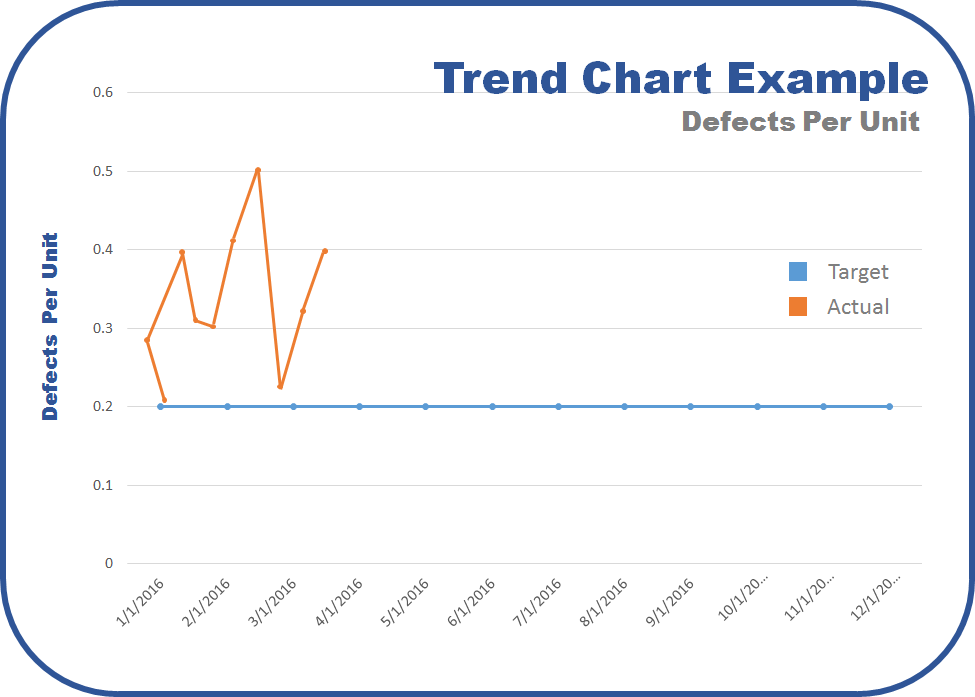
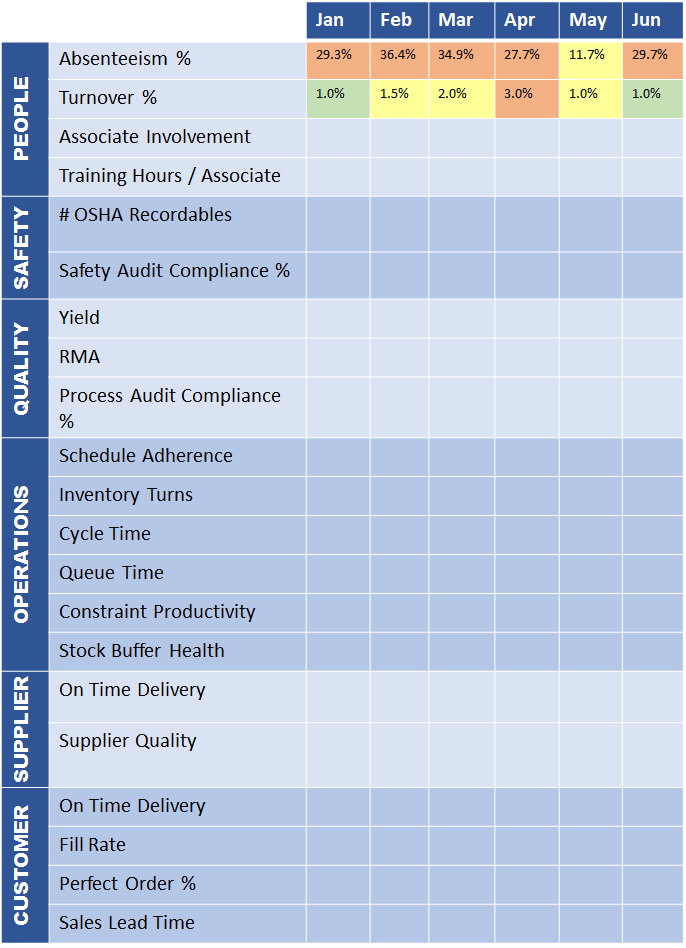
    Whether required by the CFO to prove fiscal value, or Quality Assurance to attest to improved quality and lower failure rates, all members of a Lean manufacturing operation must demonstrate performance changes over time and compare performance to targets.  This is often expressed as a trend chart.

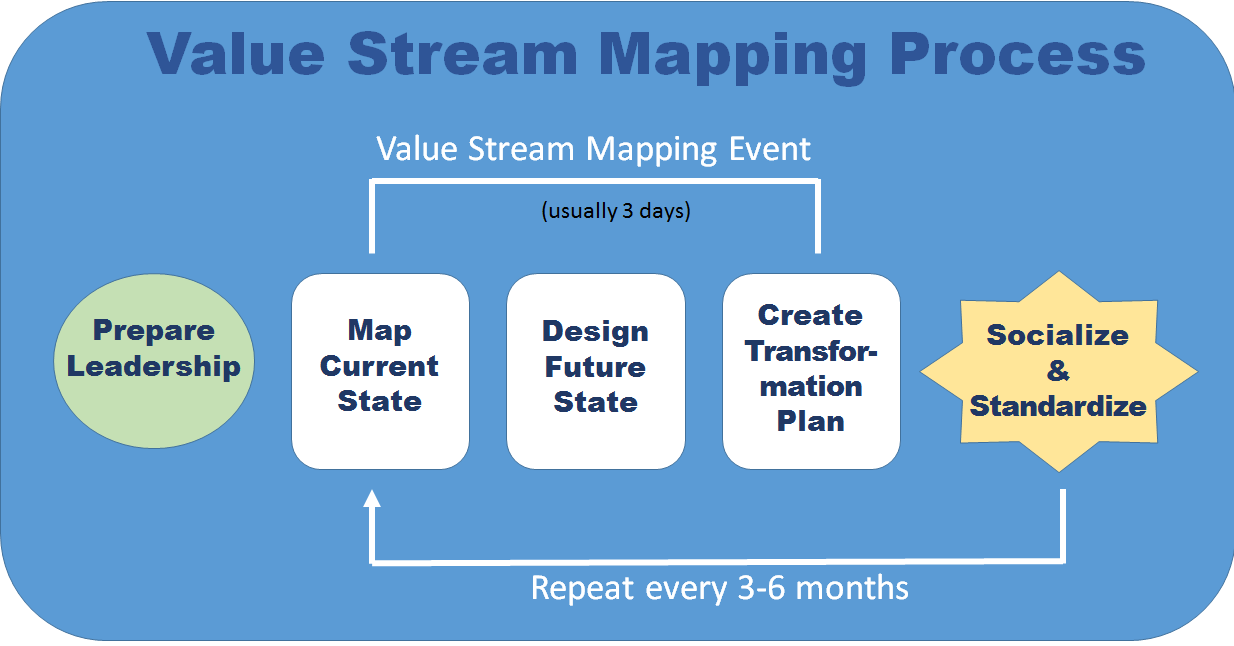
    Before looking at those trends, working through a comprehensive Value Stream Map (VSM) of the process will clearly illustrate current issues and their relative severity.

    value-stream-mapping-process

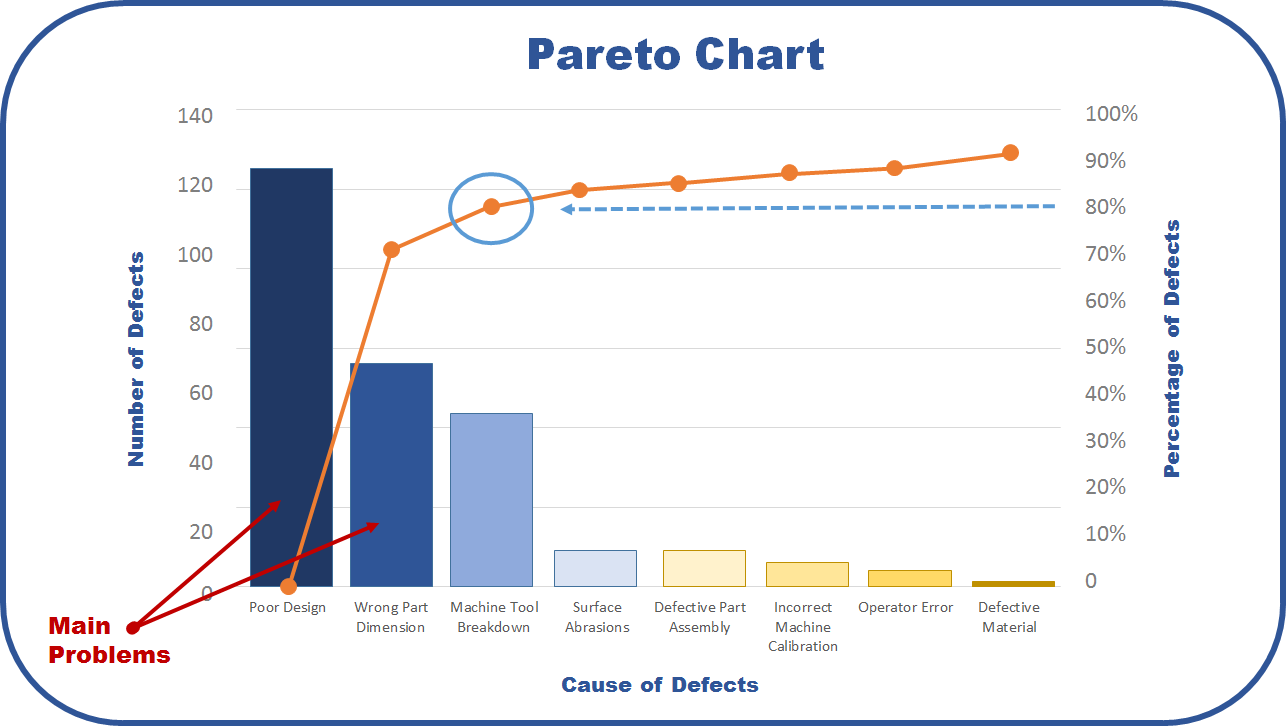
    One of the first outcomes of the VSM is often expressed as a Pareto Chart. In the graph below, the bars represent frequency or cost (time or money), and are arranged with longest bars on the left and the shortest to the right. The chart visually depicts which situations are more significant.

    Manufacturing Pareto Chart

    Past is prologue. The phrase comes from Shakespeare’s play The Tempest, where Antonio is trying to convince Sebastian to murder his sleeping father so that Sebastian can be king. His use of the phrase is intended to say to Sebastian that their lives up to this point — their past — was merely a prologue — an introduction — to the great story that they will soon embark upon if they go through with this plan. Used this way, it is meant to imply that everything that came before does not matter because a new and glorious future is ahead.

    Unfortunately, like a lot of phrases coined by Shakespeare, it has since taken on the exact opposite meaning. The way it is commonly used today suggests the past is of great importance because it defines the present and therefore sets the stage for the future. It is in this sense used very similarly to “those who fail to learn the lessons of history are doomed to repeat them.”

    Trend Chart Example - Defects per Unit

    The measurement tool in Lean manufacturing that shows historical trends about waste issues and the relative severity of past issues can be expressed as a Paynter Matrix (example above). It is a matrix of problems, faults, failure types vs. occurrence frequency (days / weeks / months) – named after Marvin Paynter of the Ford Motor Company.

    Improvement must result in a corrective action. Lean manufacturing best-practices require an Action Log (example below), which records actions that have been taken and report the effectiveness of those actions. Monitoring actionable metrics can not only provide the right data points for the Action Log, but can facilitate measurable movement in the right direction.

    Lean Manufacturing Action Log

    Metrics that Drive Action

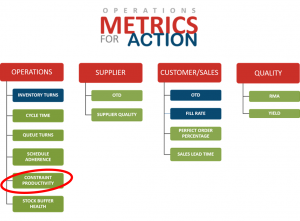
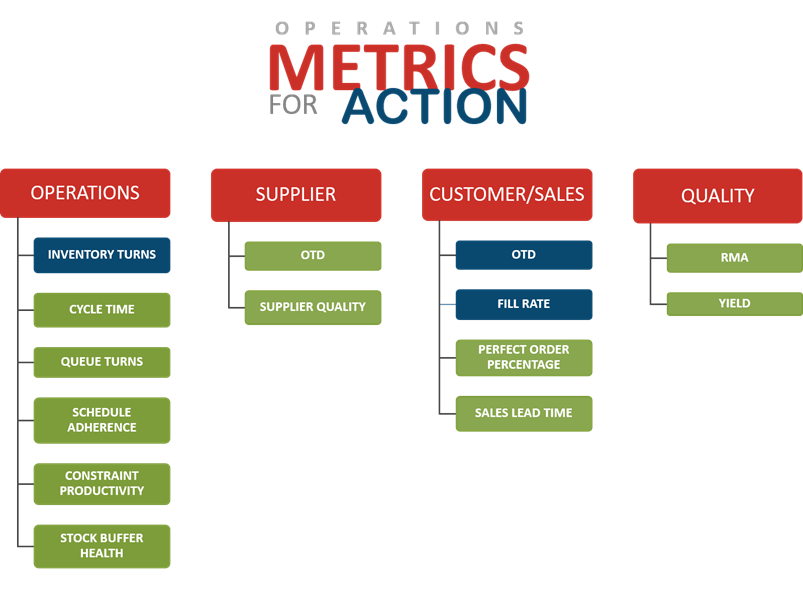
    At the beginning of this post, I mentioned that Lean teams convert vision statements into specific, actionable measures – and that they devise strategies to guide future actions for achieving desired results. The Demand-Driven Manufacturing Metrics for Action are those actionable measures. They are a proven system of metrics developed based on decades of working with manufacturers on Lean and continuous improvement initiatives. The Metrics for Action are a streamlined set of operational metrics to monitor – and that you can take immediate action on to improve. (They can also identify areas for continuous improvement.)

    Lean metrics for action

    The white paper, Demand-Driven Manufacturing Metrics that Drive Action, describes the foundation for these metrics and the Metrics for Action Guide describes each metric, how to measure it, and provides suggested actions for improvement.

    If you have used these metrics, please share any insight – or value – they provided in your organization.

    Supply Chain Brief Best Article

  • Lean Manufacturing Driven by Rapid Return on eKanban Technology Investment

    Lean Manufacturing Driven by Rapid Return on eKanban Technology Investment

    Lean Manufacturing and eKanban softwareLean Manufacturing relies heavily on trusted relationships with suppliers and pre-negotiated terms of engagement. Through the use of supplier quality certifications and blanket (long-term) purchase orders, a manufacturer can accurately and effectively calculate the optimal level of inventory needed to fulfill demand requirements through the duration of replenishment lead time.

    Ensuring supplier performance

    When a relationship is setup with a supplier, a service level agreement is defined. Items such as negotiated lead times, packaged quantities, order receipt confirmations, and advanced shipment notices must all be specifically spelled out. An eKanban Pull-based inventory replenishment system monitors that each aspect of the service level agreement is being met by the supplier in real-time. If they are not, a series of alerts and notifications are issued to all interested and affected parties. This gives everyone a chance to quickly adjust their behavior to bring performance back in line.

    eKanban software also makes all of this real-time information available for historical analysis and to identify trends in performance. Late shipments, short shipments, and other supply chain performance concerns are all captured and presented in terms of percentage of conformance to the service level agreement. These reports give everyone in the supply chain information about how to focus their continuous improvement energies.

    Eliminating inventory wasteinventory waste

    eKanban is heavily based on Lean and Six Sigma principles and tools, and adds focus to these efforts by eliminating inventory waste through real-time demand signaling and just-in-time replenishment.

    eKanban replenishment is based on the notion that if you take one, you make one. As such, you are reducing on hand inventory and not building assemblies or products without actual demand. You dramatically reduce the amount of inventory that becomes old or obsolete, free warehouse space and you build flexibility – and potential capacity – into your production process. An eKanban system exposes this flexibility so that manufacturers and suppliers can rapidly evaluate the true capability of the system to respond to a specific change in demand.

    Manufacturing operations utilizing Lean are increasingly implementing Pull systems with more suppliers. And eKanban systems are taking hold as a relatively easy, and non-disruptive way to introduce Lean thinking into the organization – and bank on a quick return. Just in “right-sizing” inventory levels alone, some manufacturers have saved millions and added tens of millions back to cash flow that can be put to use in more productive ways than filling a warehouse. Additional savings are being realized in improved supplier relationships, lead times and inventory turns – and a dramatic reduction in administrative paperwork.

    If you have an experience using a manual or eKanban system, please add a comment. I’d like to hear it!


    Additional Resources:

    Case Study: Dynisco, A Roper Company

    White Paper: Exploring Push v. Pull Manufacturing with Kanban

    Supply Chain Brief Best Article

  • Demand Driven Manufacturing in the Engineer-to-Order Space

    Demand Driven Manufacturing in the Engineer-to-Order Space

    Aligning Lean Manufacturing and Continuous Improvement Practices

    ETO manufacturing

    Demand-driven manufacturing (DDM) is an approach to manufacturing where production is based on actual demand rather than forecasts. DDM enables a synchronized, closed loop between customer orders, production scheduling and manufacturing execution – all while simultaneously coordinating the flow of materials and resources across the supply chain. The terms Pull-based manufacturing and Just-in-Time (JIT) manufacturing are also used within the context of DDM and the flow of materials.

    Synchronizing engineering and manufacturing

    Engineer-to-Order (ETO) product designers attempt to provide “mass customization” of unique, one-of-a-kind products better, faster, and cheaper than competitors. DDM methods and systems allow for many or all portions of the ETO process to be automated, providing quicker turnaround, lower engineering costs, and consistent adherence to product rules and standards. Extending Demand/Pull automation capabilities beyond manufacturing to the engineering group, ensures that they are in alignment with manufacturing production, and ultimately, customer needs. We’ve found that engineering groups who are engaged in this way realize significant increases in Engineering throughput.

    ETO, along with MTO (made-to-order), CTO (configure-to-order) and MTS (make-to-stock) environments can improve production flow and throughput (profitability) through synchronization (people, process, machines, materials and data) enabled using demand-driven manufacturing methodologies.

    Process automation and big data

    Synchronization of data improves processes, production flow and visibility. The practice of analyzing, documenting, optimizing, and automating manufacturing processes starts by evaluating value-added tasks.  Well-developed DDM systems create a seamless link from initial client contact throughout the supply chain to customer delivery. Automation of these processes improves the accuracy of the information transferred and ensures the repeatability of the value added tasks performed.Engineer-to-order (ETO) enterprises

    In addition to automation, effective ETO technology solutions drive engineering innovation. Data integration and aggregation with machines and systems across the enterprise provides insight to develop new features and additional product offerings. Instant visibility into design requirements, compliance, quality, process and machine data through a single window not only empowers engineering with essential product development knowledge and lessons learned, but provides an information platform from which they can direct continuous improvement efforts.

    Connecting and communicating through a demand-driven ecosystem

    ETO manufacturers invest in demand-driven methods based on (among other things) the value of significantly reducing lead times, engineering and manufacturing cycle times, and product rework while improving customer service, internal communication, capacity and throughput. There is additional value to the clients of ETO manufacturers when their product is of high quality, designed precisely to their requirements and delivered on time and within budget. As such, demand-driven technologies for the ETO market extend value when they create a single version of the truth through an ecosystem that connects sales/customer service, engineering, operations and the shop floor with the same, real-time information.

    With nearly 60% of ETO sales now based globally, the ability to operate in a web-based data-driven environment becomes more critical. ETO manufacturers build unique products designed to customer demand (specifications). Each product requires a unique set of item numbers, bills of material, and routings. Estimates and quotations are required to win business.

    Unlike standard products, the customer is heavily involved throughout the entire design and manufacturing process. Engineering changes are typical and material is not purchased for inventory, but for a specific project. All actual costs are allocated to a project and tracked against the original estimate. Once complete, the product is typically installed at the customer’s site. In most cases, aftermarket services continue throughout the life of the product. And while it sounds onerous, these one-of-a-kind manufacturers are thriving because they recognize the value (and growing market opportunity) in implementing manufacturing solutions based on actual customer demand. Case studies demonstrate that margins are better when proven, demand-driven solutions geared for discrete manufacturers are implemented.

    If you work in an ETO environment, I’d welcome your comments and thoughts around demand-driven and Lean practices.


    Recommended reading:

    White Paper: Why Become More Demand-Driven? Responding to Customer Needs

    Article: What is Demand-Driven Manufacturing?

    Webpage: Lean Manufacturing and Demand-Driven Value

    Supply Chain Brief Best Article

  • Demand-Driven Technologies Evolved

    Demand-Driven Technologies Evolved

    demand-driven manufacturingBy John Maher

    When I first began instituting demand-driven practices in the late 90s, we were into creating pull, eliminating waste, and getting on a path of continuous improvement. Technology at the time was seen as an inhibitor rather than an enabler. Most people active in Constraints Management and Lean Manufacturing were abandoning their technology and going to purely manual solutions. I always believed that technology was important to get the most out of the system and to make it scalable, however, in the late 90s, the lack of technologies that enabled pull made manual the only logical choice.

    One of the more fascinating developments in demand-driven enablement has been the shift of demand-driven manufacturing back to technology as an enabler rather than an inhibitor. There is recognition today that technology has to play a significant role in eliminating waste and synchronizing operations and extended supply chains. Along with this trend, the creation of open ERP systems that are easily integrated with service-oriented architecture allows companies to leverage the system they already have and benefit from today’s best-of-breed, demand-driven solutions through seamless, real-time integration. Finally, the web-based, SaaS revolution has made this process more cost effective, with expensive internal services now “downloaded” to the software provider, freeing up IT and manufacturing teams to focus on what matters. The digitization of demand-driven practices has, in effect, opened up companies’ ability to manage inventory and constraints more effectively; free up capacity; control operating expenses; drive flow; dampen variability; and create innovations to meet customer demand.

    Based on decades in this business, I have found that demand-driven manufacturers realize the most benefit when they keep their eyes on the prize: Each day, they stay focused on demand-driven behaviors and remain disciplined in their efforts. It can be a difficult road. But it is my hope that this conversation will validate why demand-driven matters and inspire you on your journey each day. Until next time, keep it Lean!


    Additional resources on this topic:

    White Paper: How Technology Will Connect Your Enterprise and Create the Demand-Driven Factory of the Future – Today

    White Paper: Why Become More Demand-Driven? Responding to Customer Needs

    Article: What is Demand-Driven Manufacturing?

  • Five Key Elements that Drive Manufacturing Flow

    Five Key Elements that Drive Manufacturing Flow

    If you follow the Demand-Driven Matters blog, you know we specialize in Demand-Driven Manufacturing and have identified the two key components of this method as synchronization and flow. At an enterprise level, synchronization is all about fully connecting your organization to aggregate and share information in real-time. Data from machines, tools, applications, enterprise systems – any data source – is synchronized to drive decision-making (In our view, this also enables the Industrial Internet of Things – IIoT.)

    Synchronization is also an enabler of flow. In this post, I want to introduce a discussion around what we’ve identified as the Five Key Elements that Drive Flow in manufacturing production. They are:

    1. Control the release – create “Pull” by gating the release of work into production.
    2. Synchronize activities – align upstream operations to downstream needs, paying attention to convergence points and final assembly.
    3. Continuous improvement – use the first two Elements as a baseline for defining areas for continuous improvement – and never get complacent.
    4. Extend to the supply chain – synchronize activities beyond the factory to the extended supply chain.
    5. Align metrics – 6 metric categories to monitor for driving action in Demand-Driven Manufacturing environments.

    On their own, each of these Elements would likely improve production flow. Our position is that by working these Elements together, you take a demand-driven leap in overall flow improvement. An episode of the podcast, Demand-Driven Matters, explains this in greater detail – along with data points on actual improvements manufacturers have gained:


    Recently, we’ve been hearing from more manufacturers who want to do more with what they have. That is, drive flow to the point that they’ve increased capacity to take on more work – or enter new markets. One client we worked with saw the Demand-Driven method – and its ability to drive flow – as a means to expand one of their business units without dramatically increasing headcount. Another client was able to use this method to free capacity to enter a new market – and doubled revenue in 2.5 years.

    In upcoming posts, we’ll review each Element in greater detail – you can also learn more about them through the Demand-Driven Matters podcast. In the meantime, let us know if you’ve worked through any or all of these Elements – and what your results were.

    Supply Chain Brief Best Article

  • Smooth the rough spots with TOC, then Lean – and fine-tune with Six Sigma

    Smooth the rough spots with TOC, then Lean – and fine-tune with Six Sigma

    What Grade of Sandpaper Will You Use? Part Four

    Demand-Driven Matters BlogHere we are at the final installment of our four-part, Sandpaper blog series about when to use the tools of Lean Manufacturing, the Theory of Constraints (TOC) and Six Sigma to address constraints, drive flow and promote continuous improvement. With regard to sandpaper, I talked a lot about what level of grit you will need to smooth out your processes—and what could happen if you try to start with Six Sigma as a first step in creating continuous improvement momentum.

    Refine with Six Sigma

    Six Sigma is the fine grit sandpaper, best used on a relatively smooth board that you want to make like glass. After TOC has helped with global flow and directed you to the location of numerous 5s and Kaizen events, you are beyond the point of dealing with special-cause variation. You identified processes that are within statistical control, but now, you need to move the baseline for the process. To do this, you need the depth of understanding that Six Sigma lends.

    I have seen countless presentations by companies that begin with Six Sigma. There seems to be this focus on how many hundreds or thousands of Six Sigma projects they performed as an indicator of the value of their continuous improvement dedication. For me, the number of projects you run in an organization that is not ready for the level of refinement that Six Sigma provides, only means doing more work, at more cost, to get fewer benefits.

    There are some improvement metrics that in my opinion, are based on funny numbers. But if you start with TOC, you can really see what is changing. That’s because TOC only impacts financials if you move Throughput (T) up, Operating Expense (OE) down, or move Inventory (I) down. (It is important to note that OE includes both direct and indirect labor.) If you take 25 percent of the labor content out of a process but there is no actual reduction to the payroll expense, then you have not impacted the financials unless that 25 percent of freed-up time can be spent increasing throughput. Six Sigma is exceedingly effective, but it can be a costly, slow, and exhausting process if you are trying to apply its fine-grit approach on a very rough board.

    The Right Tools at the Right TimeDemand-driven matters blog

    Let’s quickly go through the steps to using TOC and Lean Manufacturing—before you try to use Six Sigma to significantly move the needle.

    1) Start with the coarse grit sandpaper – TOC – to point you toward critical constraints that when managed, will provide the greatest return.

    As you maximize throughput through constraints and remove obstructions to flow, global throughput and flow goes up. This causes the next level of items impeding flow to come to light as you begin to see more global changes affected—and it creates momentum and visibility for “the next right thing” to do.

    2) Use the medium grit tools of Kaizen events and Lean Manufacturing to refine further.

    As you get rid of the more glaring impediments to flow, you begin to see where your Kaizen events should be staged. You have more data to make value stream mapping and other Lean tools smooth the process even further.

    3) The fine grit of Six Sigma is a great way to finely-tune to your continuous improvement processes.

    Six Sigma tools allow you to refine and adjust big picture items with laser-like focus. It allows you to understand common-cause and special-cause variation. So you can determine if you need to bring the process into control or overhaul the process to move to the next level of performance. These areas for improvement may have been hidden until you applied TOC and Lean tools that revealed the changes you need to make the most impact to both global improvement – and the bottom line.

    If You Could See Me Now

    When I was first working with Lean Manufacturing, TOC and Six Sigma, I made plenty of mistakes and I learned a lot about how to refine the continuous improvement journey. One of the last things I would like to say to help you— keep your eyes open.

    A very wise man once said there is a vast difference between looking and really seeing something at depth. I found for myself that when I look at the surface of the issue, I don’t make as much progress as when I try to really see. If you keep these methodologies at hand and combine them with the ability to see (with context and clarity) what to do next to keep your continuous improvement ball rolling, you’re sure to experience great improvements for you, your processes and your people. Let me know what you are doing to keep the continuous improvement fire burning at your company.

    -John Maher

    This is part four of a four-part series. Here are the links to the earlier posts in this series:


    John Fast Results Using TOC for Demand-Driven Manufacturing - Part Two

    John’s passion for demand-driven manufacturing is equal to his interest in how this method improves the lives of employees within these environments. “I’m here to help, not to judge” comments John whose posts reflect why demand-driven matters and are based on his experience working in manufacturing environments and expertise in ERP, MRP, APS, supply chain, manufacturing planning and scheduling systems and constraints management.

    Supply Chain Brief Best Article

“test”